Self-Hosted LLM in 2026: When the Bill Justifies Running Your Own Model
Revolut serves an open-weight model to about 2,000 engineers on 56 GPUs at 30 cents per million tokens. The break-even formula behind a self-hosted LLM, the one-node floor a smaller team hits first, and the router that keeps it safe.
In October, Revolut's David Abitbol gave the AI Engineer conference in New York the number every CTO with a growing LLM bill wants to hear: serving an open-weight model to about 2,000 engineers costs the bank a blended 30 cents per million tokens, and the invoice is a tenth of what it paid Anthropic and OpenAI. The Register reports it as roughly 90 percent lower AI coding inference costs.
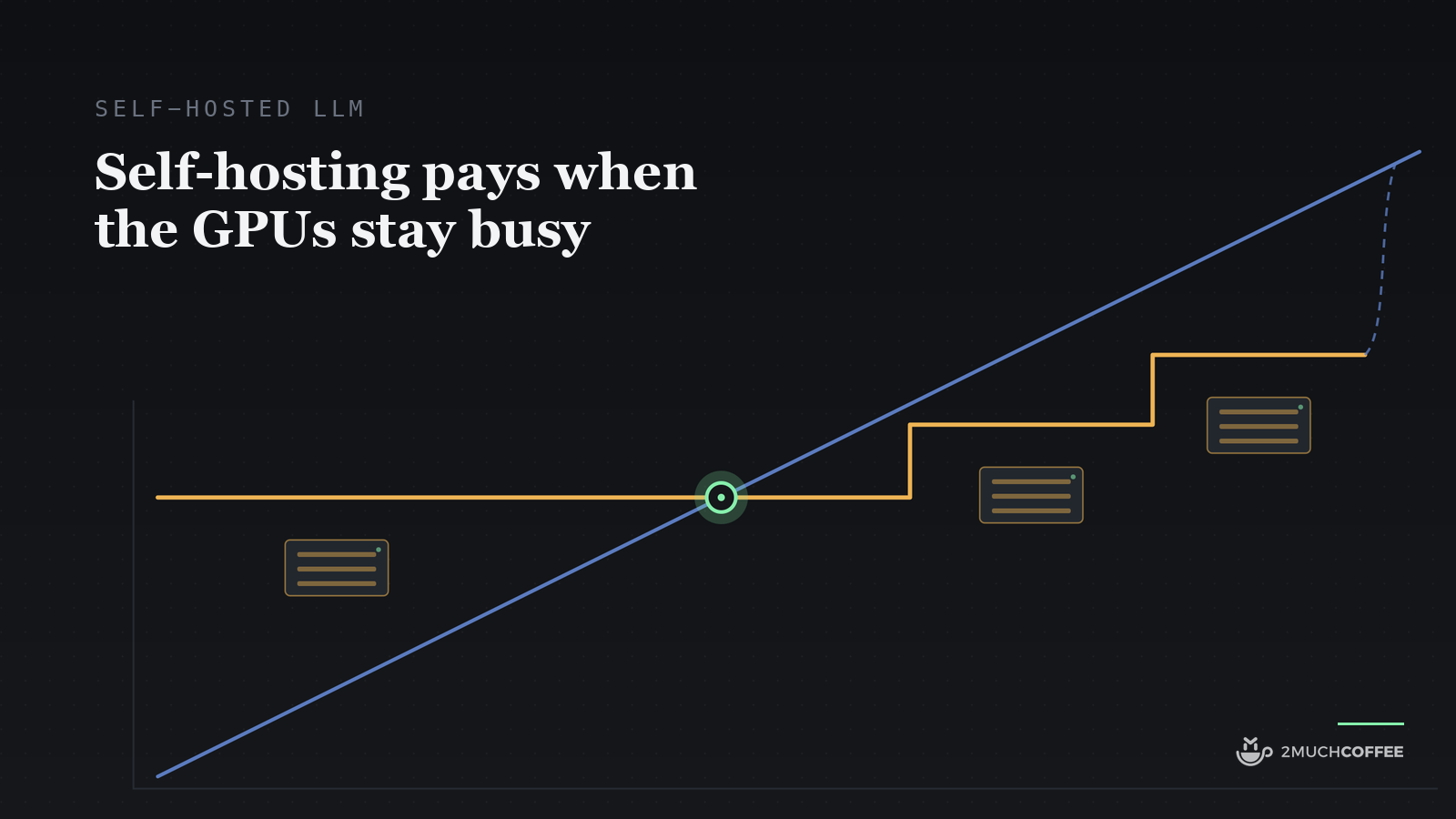
The number I would look at first is a different one. To serve those engineers, Revolut runs roughly 56 Nvidia B200 GPUs, and GPU capacity costs the same busy or idle: a rented cloud GPU is billed for as long as it runs, idle time included. A self-hosted LLM swaps a price per token for a price per GPU-hour, so the decision comes down to how many of those hours your traffic actually fills.
Here is the plain version. A self-hosted LLM is an open-weight model, such as GLM, Qwen, DeepSeek or OpenAI's gpt-oss, running on GPUs you rent or own, behind an endpoint your team operates. You pay for the hardware and the people who run it, and every extra token that fits in that capacity costs close to nothing; past it, the next token needs more GPUs.
It pays when three things hold: the volume is steady enough to keep the GPUs busy through the working day, the task fits an open model on your own evaluations, and someone owns the cluster. A router that sends everything else to a hosted model is what makes the arrangement safe to run.
What Revolut runs, according to the talk
The recording is on the conference's own channel and runs under twelve minutes, and the official schedule lists it on 13 October on the main stage. It is the best primary source this story has, so the figures below come from Abitbol's own words.
Revolut first rolled out Claude Code with strict budget limits, because some engineers were spending a thousand to ten thousand dollars a month for too little return. The goal became unlimited tokens, so that engineers could use AI guilt-free for a fraction of the cost, and in April the bank started self-hosting GLM.
Today it serves GLM-5.3 to about 2,000 engineers on roughly 56 B200s, the GPU count of seven eight-GPU DGX B200 systems. The latency targets are plain: under three seconds to the first token, with complaints starting past five, because as Abitbol puts it, his Slack inbox starts to blow up.
Abitbol says raw throughput matters less. Revolut serves about 200 tokens a second of interactive generation, because engineers now run tasks in parallel and check back when they finish, and anyone who logs in after 5 pm gets closer to 800 on the same GPUs. The fastest model at Revolut is the one you use after everyone else has gone home.
The commercial tools stayed. Abitbol's summary is that the billing is flat and that Claude Code and Codex remain in use as the exception. GLM-5.3 is text-only, The Register reports, so a model router sends vision queries to hosted models such as Gemini or GPT Luna while code generation stays on GLM.
Two details in that list carry more weight than the 30 cents. The fleet is a fixed 56 GPUs for about 2,000 engineers, tuned until the latency target held, and the hosted frontier models kept a door into the workflow. Revolut changed its default model and kept the rest within reach.
The break-even formula
Paying per token, the bill grows in a straight line with use. Paying per GPU hour, it grows in steps, because one node costs the same at a quiet weekend as at Tuesday's peak. The break-even is where the line crosses the first step, and two numbers decide where that is.
The first is the monthly cost of the hardware your peak needs, plus the people who keep it running: GPUs times the hourly rate times 730 hours, plus the share of an engineer's month that goes to the cluster. The second is your blended hosted price per million tokens. Divide the first by the second and you get the monthly volume, in millions of tokens, above which self-hosting wins on cost.
Use the blended price from your invoice. For a coding agent, where most input is repeat reading and output is a small share of the tokens, the blend sits well below the fresh-input list price. Claude Code, for one, sends the full conversation with every request and re-reads that history at the cached token rate, and Anthropic's pricing page lists $0.10 per million tokens for a Sonnet 5.5 cache hit, against $2 for fresh input and $10 for output; output still costs five times a fresh input token, and cache writes bill at $2.50 to $4 per million, so the mix matters.
On Revolut's self-hosted GPUs, Abitbol tunes coding traffic for a cache hit rate above 90 percent, which suggests how much of a coding agent's input is repeat reading. If your hosted traffic caches as well, about nine in ten input tokens bill at the cached price; the cache-read line on your invoice says whether it does.
Revolut's 30 cents is itself a blend: The Register describes it as the price per million input and output tokens together. Work out your own blend before you hold it against theirs. The calculator below runs the formula on your numbers; its defaults are example inputs with their sources named.
Break-even calculator: GPU hours against per-token prices
Self-hosted cost = GPUs × hourly rate × 730 + people. Break-even volume = self-hosted cost ÷ blended hosted price per million tokens. Change any field.
Example defaults, checked 12 November 2026: eight B200s at the on-demand $7.69 per GPU-hour Lambda lists for an 8x HGX B200 instance, before tax, a list price Lambda says takes effect on 16 November 2026; Claude Sonnet 5.5 list prices ($2 fresh input, $0.10 cache hit, $10 output per million; cache writes bill at $2.50 to $4, so a high miss rate costs more than the fresh-input field shows); a 90 percent cache hit rate, the floor Revolut's David Abitbol gives for coding traffic on its self-hosted GPUs, used here as a stand-in until you read your cached share off your own invoice; 2 percent output share and 20 billion tokens a month as placeholders for your own logs. People cost starts at zero so you enter your own. The formula covers cost only: the GPUs also have to serve your daytime peak at your latency target, and Revolut serves about 2,000 engineers on roughly 56 B200s, a count that met its latency target only after months of tuning.
The floor a small team hits first
For a frontier-class open model the practical unit is four to eight data-center GPUs. GLM-5.3, the model Revolut serves today, has 753 billion parameters. Its predecessor GLM-5.1 is a separate model, and The Register puts its weights alone at roughly 380 GB of GPU memory, plus the KV cache, the memory each live session holds on the GPU. Abitbol found that GLM fits on four GPUs with too little room left for that cache, so eight can serve better, depending on the workload.
Rented at the on-demand $7.69 per GPU-hour Lambda lists for an 8x HGX B200 instance, a list price it says takes effect on 16 November 2026 (read on 12 November), an eight-GPU node costs about $44,900 for a 730-hour month before tax, before anyone has tuned it; Lambda's 4x B200 instance at $7.79 per GPU-hour comes to about $22,700, and for a team of 30 the eight-GPU node is about $1,500 per engineer per month, inside the range Abitbol says some Revolut engineers were spending before the switch.
Scale the same arithmetic up and the answer flips. Priced as seven separate eight-GPU instances at the same Lambda list price, a fleet the size of Revolut's would rent for about $314,000 a month, or about $157 per engineer across 2,000.
Lambda lists its interconnected B200 clusters higher, reserved for two weeks to a year at $9.86 per GPU-hour for 16 GPUs and $9.36 for 64; a 64-GPU cluster, the smallest listed size that covers Revolut's 56, comes to about $437,000 a month, or about $219 per engineer, and CoreWeave's on-demand $68.80 an hour per eight-GPU B200 node, from its own pricing page, comes to about $352,000, or $176 per engineer.
The talk leaves Revolut's commercial arrangement unstated, though its slides suggest dedicated capacity at Together AI: the latency chart is sourced from Together AI's metrics API, and the tuning list names Together AI's Dedicated Model Inference. Treat the figures above as a rental benchmark.
The useful ratio is the one underneath: on Revolut's numbers, roughly 56 B200s for about 2,000 engineers works out to about 36 engineers per GPU, or roughly 290 per eight-GPU node's worth of capacity, averaged across a fleet that pools everyone's demand, after months of tuning. Even on that generous average, a team of 30 would keep about a tenth of one node busy and pay for all of it.
Buying instead of renting gives the same logic a number. A break-even post on r/LocalLLaMA, written by someone who works at a company that sells and hosts GPU servers, and says so, priced an eight-GPU H200 server and, against the on-demand H200 median rental rate it assumed, concluded that owning wins at roughly 60 percent sustained utilization over two years, and renting wins below 40.
The useful part is the post's list of what that hardware-only figure leaves out: power and cooling, depreciation, idle hours and the owner's own time. Every item on it lands on whoever runs the cluster.
There is a smaller tier that fits a smaller team. OpenAI's gpt-oss-120b, released under Apache 2.0, runs on a single 80 GB GPU thanks to MXFP4 quantization of its MoE weights, and one H100 SXM at Lambda's $4.89 an hour, the same 16 November list price, comes to about $3,600 a month before tax; the PCIe version lists at $3.79, about $2,800. That buys a capable model for narrower jobs: extraction, classification, summaries over private documents, a first-pass reviewer. Run it against a golden set of your own cases before it takes any work from the frontier model.
Renting open weights by the token
Between a hosted frontier model and your own GPUs sits a third option: the same open weights, rented per token from someone else's cluster. Z.ai, which publishes GLM, lists GLM-5.3 per token on its pricing page, with a separate cached-input rate, and its API data processing addendum says customer data is generally processed in Singapore.
Amazon Bedrock added managed open-weight models in February, among them GLM 4.7, Qwen3 Coder Next and DeepSeek V3.2, with OpenAI-compatible APIs, and the host runs the serving stack. Its pricing page lists Qwen3 Coder Next and DeepSeek V3.2 at standard on-demand rates in its US regions, with no discounted rate listed for cached input. Host catalogues move too: Bedrock has put GLM 4.7 into Legacy with an end-of-life date next spring, and Legacy models are closed to new customers.
Compare blends before you compare hosts. On the calculator's coding mix of 90 percent cache hits and 2 percent output, our arithmetic on each host's list prices, from the pricing pages named above, puts Z.ai's GLM-5.3 at about 45 cents per million tokens, the two Bedrock models at about 51 and 64 cents with every input token at the fresh rate, and Sonnet 5.5 at about 48 cents if every cache miss bills at the base input rate, more once cache writes count. Revolut's blended 30 cents sits under all of them, and that gap is what its volume and tuning buy.
| Hosted frontier API | Open weights, rented per token | Self-hosted open weights | |
|---|---|---|---|
| Volume it suits | Spiky traffic and the hardest tasks | Steady traffic below one busy node | Steady traffic that fills nodes through the working day |
| Data boundary | The vendor's terms; zero retention by arrangement with sales, on eligible models; US-only inference at a premium | Depends on the host: Z.ai says its API data is generally processed in Singapore; Bedrock stores content at rest in your AWS Region | Hardware you control |
| Model changes | On the vendor's retirement schedule | On the host's catalogue | When you decide to upgrade |
| Who runs it | The vendor | The host | A named owner on your team |
| What it is best at | Frontier reasoning, vision, the long tail | Bulk work an open model passes | The bulk of your daily traffic |
The GPUs are the easy part
Abitbol is blunt about the naive setup: just get GPUs, load the weights, start serving, and you get terrible performance, because the workload depends on the parameters you set. Revolut started self-hosting in April, and Abitbol puts the starting point at over ten seconds to first token, at about three requests a second, on the same 56 GPUs it still runs.
His slide puts numbers on the last stretch: from the mid-migration dip to the stable setup in late August, requests per second rose 76 percent, from 3.38 to 5.95, and time to first token fell 88 percent, from 14.26 to 1.68 seconds, on the same 56 B200s. The slide's title is the lesson: resist scaling, tune first.
The knobs he names are the ones an owner keeps turning: a context cap of 256 thousand tokens, even though the model can serve a million, and NVFP4 quantization with disaggregated prefill and decode.
Defaults move under you as well. Serving Kimi K2.6 on vLLM, Ubicloud measured the expected tool-call schema 92 percent of the time, and 100 percent once a server-side constrained-decoding flag was switched on. By Ubicloud's count that is 2 failures in every 25 calls, and in a multi-turn agent session the errors pile into the context, the agent retries and output quality drops. Somebody has to know that flag exists.
Add tensor parallelism sized for KV cache headroom, TP8 over TP4 once the cache runs short, a cache hit rate kept above 90 percent for coding traffic, and OpenTelemetry deep enough to dig through the logs after an incident. Then the upgrade each time a new GLM point release lands, and the evening pager.
That is the third condition in practice. Budget the person who owns the serving stack in the formula before you budget the GPUs; the GPUs are the part you can order.
When the data has to stay inside
For a regulated team, cost is often the second question. The first is where the prompt goes, and the hosted options have answers worth reading before anyone buys hardware.
Anthropic offers a zero data retention arrangement, requested through its sales team, under which it keeps no copy of prompts or responses at rest once the API response is returned. The same page lists exceptions, including data the law requires it to keep, sessions its automated trust and safety systems flag, which it may keep for up to two years, and the Fable and Mythos 5 and 5.1 models, which require 30-day retention and sit outside ZDR unless Anthropic expressly authorizes them.
Stateful features such as the Batch and Files APIs and code execution also sit outside the arrangement, under their own retention policies.
It also sells US-only inference at 1.1 times the standard token price.
Amazon's Bedrock FAQ says your content is not used to improve the base models and is not shared with any model providers, and stores it at rest in the AWS Region you use.
Self-hosting is the answer when the policy names the hardware: the data stays on machines you control, or the model has to stay fixed for an audit trail.
Hosted models retire on the vendor's clock. On its own API, Anthropic notifies customers with active deployments at least sixty days before retiring a publicly released model, and Claude Sonnet 4.5 leaves the Claude API at the end of November. Amazon Bedrock, where it went Legacy in October and is closed to new customers, keeps it for active existing users until early April. Weights you hold stay the same model until you choose to change them.
A commenter on r/LocalLLaMA who says they work in AI at a large bank described the rule from the inside: development there mostly runs on Claude, but a model built into a product has to be self-hosted: if a decisioning engine is built on an LLM, the model has to behave exactly the same way every time, frozen against changes and updates.
Abitbol told the CIOs in the room that there has been a lot of stigma around Chinese open-weight models, and that the point to consider is the path the data takes: instead of calling the inference endpoint that goes to China, you take the weights and put them on a US-based service. For a team regulated elsewhere, the same logic points at serving the weights inside your own jurisdiction.
He also describes a sandbox that keeps a human in the loop, with rules for which operations the agent may run, which is how Revolut, an EU-regulated bank, reassures its regulator that the coding agent is not an autonomous agent.
Read the licence on every point release. GLM-5.2 shipped under MIT, while GLM-5.3 ships under its own licence that adds a security review for model-as-a-service companies above a high revenue threshold. The clause targets companies that sell inference or fine-tuning access to third parties, and legal will still want to read a licence change before your upgrade ships.
A router is what makes it safe
Revolut's self-hosted endpoints are OpenAI-compatible, with the Responses API, and Abitbol recommends them inside OpenCode, Codex and the Codex app. GLM-5.3 reads text only, so for image work Abitbol suggests a local router that sends it to a vision model while GLM keeps the main task. A router in front of every model is the step beyond that.
vLLM, one of the serving engines GLM-5.3's model card lists, ships an OpenAI-compatible HTTP server, and Bedrock's open-weight models take the same API shape, so for a plain chat request the switch between your GPUs and a rented open model comes down to a base URL, a key and a model name. Read each provider's compatibility notes first: Anthropic describes its OpenAI SDK compatibility layer as meant mainly to test and compare models, and it skips prompt caching, so Claude traffic belongs on the native API behind the router.
The router's rules, in the order it should apply them:
- Data class: a request carrying regulated data goes only to targets inside its boundary, and that check runs before any cost rule.
- Capability: images, and any task the open model fails on your evaluations, go to a hosted model.
- Capacity: when the queue pushes time to first token past your budget, five seconds at Revolut, overflow goes to a hosted endpoint, ideally the same open model rented per token so answers keep their style.
- Exception: an engineer can still pick the frontier model for the hardest task, the way Revolut kept Claude Code and Codex.
Pin each session to one model once the router has chosen it; Revolut's tuning list includes sticky sessions, the same idea inside its own fleet. Switching models mid-conversation throws away the prompt cache that makes coding traffic cheap, which is the objection Hacker News readers raised against a per-request router for coding agents. The router also carries the fallback for the day a node fails, and on your own hardware that day comes.
A router suits interchangeable traffic: chat and agent requests in one API shape, where any capable model can answer. Some product calls depend on guarantees whose exact behaviour differs between providers and models, such as forcing a particular tool call or enforcing a strict output schema. Keep those as one small integration per job, with the provider chosen for that job, so the router carries the volume while those few calls stay with the model they were built around.
A local LLM for coding is a different decision
Running a coding model on your own machine is usually one developer and one laptop, and the hardware is already paid for. OpenAI says gpt-oss-20b runs within 16 GB of memory, and Qwen3-Coder-30B-A3B activates 3.3 billion of its 30.5 billion parameters per token; both carry Apache 2.0 licences.
The people who made the switch describe it in an Ask HN thread from June: mid-sized mixture-of-experts models on a single high-end consumer GPU or a high-memory Mac, chosen for privacy and a flat cost. The replies split on quality, from one developer rating it like frontier models of eight to twelve months earlier to another calling home-sized models nowhere near Opus.
A laptop-sized model handles completions, explanations of unfamiliar code, small refactors and anything that has to stay on the machine. Multi-file agent work, where the model plans, edits and reruns the tests, wants a model in the GLM-5.3 class, and that model needs a node. On a laptop the question is privacy and convenience for one person, and the team decision goes back to the formula above.
Where our own self-hosting fits the rule
We route or self-host where a requirement calls for it, and the self-hosted pieces we have built share the shape the rule asks for: a steady job that one open model or one engine does end to end.
Speech-to-text is the clearest. For Notesign, an AI EdTech platform, we built WhisperX speech-to-text at scale, with word-level timestamps and speaker labels on long lecture audio. WhisperX is open-source code under a BSD-2-Clause licence, built on OpenAI's MIT-licensed Whisper model, and transcription is a steady, well-defined job, the kind where compute you pay for by the hour can stay busy.
Retrieval is the second. The matching agent in our hybrid search teardown runs its search on a self-hosted Qdrant under a LangGraph agent, so the index and the search sit on our infrastructure.
For the reasoning model in a client system, the same order applies: put the router in first, measure the slice an open model handles on the client's own cases, and size hardware for that slice once its volume is known.
FAQ
What is a self-hosted LLM? An open-weight language model, such as GLM, Qwen, DeepSeek or OpenAI's gpt-oss, running on GPUs you rent or own and served behind an endpoint your team operates. You pay for hardware hours and the people who run them instead of a price per token, and prompts stay on infrastructure you control.
Is a self-hosted LLM cheaper than an API? At steady, high volume it can be much cheaper: Revolut puts its blended cost at 30 cents per million tokens and its invoice at a tenth of its previous hosted spend, for about 2,000 engineers. Below the break-even volume, the GPUs' monthly cost divided by your blended hosted price per million tokens, a hosted API or open weights rented per token cost less, because a rented GPU is billed for the time it runs, busy or idle. Compare your blended price per million tokens, cache hits included, with the monthly cost of the GPUs your peak needs.
How many GPUs does a self-hosted LLM need? It depends on the model. OpenAI's gpt-oss-120b runs on a single 80 GB GPU, thanks to MXFP4 quantization of its MoE weights. A frontier-class open model needs four to eight data-center GPUs: The Register puts the weights of the earlier GLM-5.1 at roughly 380 GB of GPU memory, Abitbol found that eight GPUs can serve GLM better than four, depending on the workload, and Revolut serves GLM-5.3 to about 2,000 engineers on roughly 56 B200 GPUs. Size for your daytime peak at your latency target, with memory left for every live session's KV cache.
Which local LLM fits a coding workstation? Models built for one machine. OpenAI's gpt-oss-20b runs within 16 GB of memory, and Qwen3-Coder-30B-A3B activates 3.3 billion of its 30.5 billion parameters per token; both are Apache 2.0. They suit completions, explanations and small edits on code that has to stay on the machine. Multi-file agent work wants a much larger model, which means a server.
Is it safe to self-host a Chinese open-weight model? Start with where the data travels. Revolut's David Abitbol told the CIOs in the room that the thing to consider is the inference endpoint in China, and that taking the weights and putting them on a US-based service is fine for data sharing. The same logic applies wherever your data has to stay: serve the weights on infrastructure inside that boundary. Read the licence for each release, since GLM-5.3 ships under its own licence where GLM-5.2 used MIT, and review the serving stack the way you review any other dependency.
What does a model router do in a self-hosted setup? It sits in front of every model behind one OpenAI-compatible endpoint and decides where each request goes: regulated data only to targets inside its boundary, images and tasks that fail your evaluations to a hosted model, overflow to a hosted endpoint when time to first token passes your budget, and the hardest tasks to a frontier model on request. According to The Register, Revolut's router sends vision queries to hosted models such as Gemini or GPT Luna.
What 2muchcoffee covers
We add AI to existing products on your own data and under your privacy constraints, and we route or self-host where a requirement calls for it. If your LLM bill is climbing and part of the traffic looks like a job for an open model, the first step is the router and an evaluation set, ahead of any hardware. That is the AI integration work we do.
One concrete action
Export last month's usage by task type: the coding agent, the chat assistant, the extraction jobs, whatever your logs can separate. Mark the tasks an open model passes on twenty of your own cases, add up their tokens and multiply by your blended price. If that comes in under one node's monthly cost at your peak, rent the open weights by the token and put the router in front; if it comes in over, you have the first line of a hardware budget.