Claude Code vs Cursor in 2026: Which One a Team Should Standardize On
Cursor grew out of a code editor, with Agent in the side pane next to the file; Claude Code is an agent that works from the terminal and the repository. For a team, the choice turns on where the work happens, what a seat buys on Cursor's new October plans, and one rules file both tools read.
 Updated
The Cursor vs Claude Code question usually reaches an engineering manager as a budget line. Half the team works in Cursor, the other half in Claude Code, and the renewal asks for one seat licence.
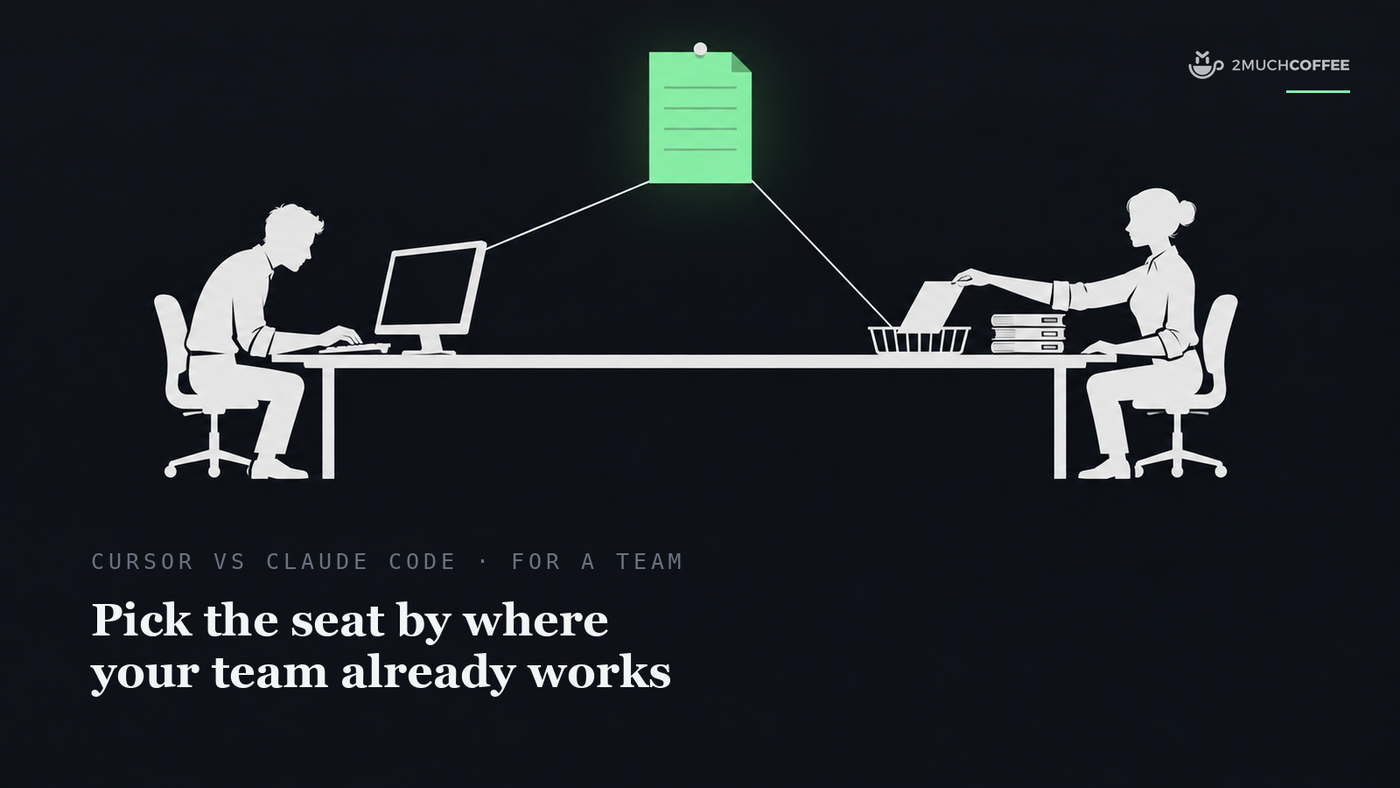
Here is the plain version. Cursor grew out of a code editor: you work inside the file, and Agent works beside you in the side pane. Claude Code is Anthropic's coding agent, and it works from the terminal and the repository: you hand it a task, it edits the files and runs your tests, and your team reviews the changes it hands back. Each now reaches into the other's ground, so for a team the useful question is where the work already happens, in the editor or in a written task that ends in a pull request.
Since 12 October, when xAI launched The X Subscription, one plan for Grok, Cursor and X, the budget line also reads differently for new customers. On those plans the included usage covers Cursor's own models, Grok and Composer, and Claude inside Cursor bills at API list price from the first request, from the Premium tier up. Customers already on the older Cursor plans keep their plan, price and included usage unless they switch.
A Claude Team seat includes Claude Code, and that work counts against the usage limits for the member's assigned seat. If your Cursor half is on the new plans and spends the day on Claude models, the two tools charge for that work in two different ways.
We use both at 2muchcoffee. Our AI page says most of what we ship is written with AI in the loop, mostly Cursor and Anthropic's models, and Claude Code is part of how our engineers deliver from the written spec through review. If your choice is between the two terminal agents, we measured Claude Code against Codex on two real tickets. Below: what each tool is in November, what a seat buys, which team shape fits which, and the one rules file that lets a team run both.
What each one is this November
Cursor began as an AI code editor and has added agents around it. Tab, its autocomplete, predicts the next edit as you type, including edits in other files. Agent sits in the side pane, edits code and runs terminal commands. Since Cursor 3 it also has an Agents Window, an agent-first interface for running agents in parallel beside the editor.
Around that core, Cursor ships a command-line agent with a print mode for scripts and CI, Cloud Agents that work in their own virtual machines and open pull requests, and Bugbot, which reviews pull requests. In August Cursor became part of SpaceX, and the models its current plans include are what Cursor calls its own: Grok and Composer.
Claude Code is Anthropic's agent, and it has spread across surfaces. Anthropic describes it as a tool that reads your codebase, edits files, runs commands and works with git, from staging a change to opening a pull request. It runs in the terminal, in VS Code and JetBrains, in a desktop app and on the web, and its VS Code extension installs into Cursor too.
For pipelines it has a non-interactive print mode, claude -p, plus GitHub Actions and GitLab CI/CD, the last in beta and maintained by GitLab. On Team and Enterprise plans, Code Review reviews GitHub pull requests automatically, billed separately through usage credits. It runs on Anthropic's Claude models, Sonnet for most coding tasks and Opus for harder reasoning.
| Cursor | Claude Code | |
|---|---|---|
| Home ground | The editor: Tab, inline edits, Agent in the side pane | The terminal and the repository: a task in, changes for review out |
| Also runs as | Agents Window, command-line agent, Cloud Agents | VS Code and JetBrains extensions (inside Cursor too), desktop app, web |
| Models the plan includes | Cursor's own on current plans: Grok and Composer | Anthropic's Claude models |
| Claude models | Premium tier and up on current plans, at API list price from prepaid credit; Teams and Enterprise add Cursor's token rate | Inside the plan's usage limits |
| Headless and CI | agent -p | claude -p, GitHub Actions, GitLab CI/CD |
| Pull-request review | Bugbot, Premium tier and up | Code Review on GitHub (Team and Enterprise, billed separately), or a review workflow in GitHub Actions |
| Project instructions | .cursor/rules, AGENTS.md, Team Rules | CLAUDE.md, or by default AGENTS.md when there is no CLAUDE.md |
Table sources, read in early November: Cursor's pricing docs, rules and CLI pages; Anthropic's Claude Code overview, headless mode, GitHub Actions, Code Review and memory pages.
Each tool now covers most of the other's list. What still differs is the default: where each one puts the engineer, and which models the plan pays for.
What a seat buys since Cursor's October change
Cursor's current plans, from its pricing docs, are Free, Plus at $8 a month, Premium at $30, Super at $100 and Ultra at $200, and Teams pay $30, $100 or $200 a seat, with each member getting a Premium, Super or Ultra seat with the matching usage. Every paid plan carries one weekly pool for Cursor's own models, shared with the Grok apps on the same subscription, and on Teams each paid seat has its own.
Claude, GPT and Gemini sit outside that pool. From Premium up they run in Cursor at the model's API list price from the first request, paid from prepaid credit, and Plus runs Cursor's own models only. On Teams and Enterprise, eligible third-party requests also carry a Cursor token rate on top of the API price. Customers on the older plans, Pro, Pro+, Ultra and the Teams Standard and Premium seats, keep them as they are, with their two monthly pools, and existing teams can still add seats on them.
Anthropic's side, from its pricing page, is Pro at $20 a month, Max at $100 and Ultra at $200 for individuals, and Team seats at $25 a month for Standard or $125 for Premium, $20 and $100 when billed annually. Claude Code comes with every Team seat, and when a member reaches the included limit, an Owner can turn on usage credits, prepaid and billed at standard API rates, to keep them working.
| Seat | Cursor (The X Subscription) | Anthropic (Claude Code) |
|---|---|---|
| Entry paid plan | Plus, $8 a month, Cursor's own models | Pro, $20 a month ($17 billed annually), Claude Code included |
| Heavy individual use | Super $100 (15x Plus usage), Ultra $200 (50x Plus) | Max $100, Ultra $200 |
| Team seat | $30, $100 or $200, matching Premium, Super or Ultra | Standard $25 ($20 annual), Premium $125 ($100 annual), Claude Code in both |
| What included usage covers | Grok 4.7, 4.6, 4.5 and Composer 2.5, one weekly pool shared with Grok Bot and the Grok apps | Max 5x Pro every 5 hours and every week, Ultra 10x Pro weekly with no 5-hour limit for verified accounts, Premium seats 5x Standard; on Pro, Max and Ultra, Claude and Claude Code count against the same limits |
| Claude models | Premium and up, API list price from the first request, plus $0.25 per million tokens on Teams and Enterprise for models whose cache reads cost $0.10 per million or more: today Sonnet 5.5, Opus 5.5 and Fable 5.1 pay it, Haiku 5.5 is exempt | Opus, Sonnet and Haiku inside the seat's limits; Fable up to half the weekly limit on Max, Ultra and Premium seats; past the limit, usage credits at standard API rates once an Owner turns them on (Team) |
| Enterprise | Custom price, pooled usage | $20 a seat a month billed annually, 20-seat minimum, plus usage at API rates |
Read 4 and 5 November 2026 from cursor.com/pricing, Cursor's models and pricing docs and legacy-plans page, claude.com/pricing, and Anthropic's support articles on Claude Code for Team and Enterprise plans and on usage credits. The Cursor column is The X Subscription, which new customers start on; Cursor's older plans (Pro, Pro+, Ultra, Teams Standard and Premium seats) continue for existing customers. Prices exclude tax and change often.
For a team, that splits into three cases.
- Engineers who mostly run Cursor's own models get the most from a Cursor seat. The weekly pool covers them, and Cursor's announcement puts each new plan at at least twice the coding usage with Grok models of the comparable Cursor plan. The same weekly pool also covers the Grok apps, so an engineer who uses them spends one seat's allowance in two places.
- Engineers on the new plans who run Claude all day pay API list price for each Claude request, from prepaid credit or their own API key, and on Teams and Enterprise Sonnet, Opus and Fable also carry Cursor's token rate. Through Claude Code the same work draws on a Team seat already paid for, then on usage credits at standard API rates if an Owner has turned them on.
- Teams on an older Cursor plan keep their pools and can still add seats on it. The question arrives the day they choose to switch, which Cursor says is optional and permanent.
In r/cursor, when a Claude-only Ultra subscriber asked whether to switch, replies pointed out that the Claude Code extension runs inside Cursor itself, so you keep the editor and bill the work to your Claude plan. That is also the answer to a question that turns up in forums, why use Claude Code when Cursor already gives you Claude: on the new plans, Cursor sells you Claude by the token.
Editor-first or task-first: which team shape fits which
An editor-first team reads each change as it is written. The engineer keeps a hand on every line: accepts or rejects a Tab suggestion, asks Agent for a refactor in the side pane, watches the diff land in the file. Review happens continuously, by the person who will answer for the code. This shape suits interface work, inherited code the engineer is still learning, and changes small enough to steer by eye. Cursor is built around it.
A task-first team writes the work down and hands it over. A ticket with acceptance criteria goes to the agent, the agent works through it in a branch and runs the tests, and the engineer reviews a finished diff in a pull request, often with two or three sessions running side by side. This shape suits a backlog of well-specified tickets, test backfills, migrations and dependency upgrades, on a team that already reviews pull requests with care. Claude Code is built around it, headless runs in CI included.
Users draw the same line. In an October r/cursor thread, one reply described the split that stuck: Cursor for sitting in the editor and steering a change file by file, Claude Code for a task bigger than one screen that can run in the background. In a January thread on Cursor's own forum, a Cursor user put the editor case in one line, that they need an IDE to review every task, and many replies said they run both.
But the crossover is real now. Cursor's command-line agent and Cloud Agents cover task-first work, and Claude Code inside VS Code or Cursor covers much of the editor-first loop. So a team decides on habit and on model: where its engineers already review, and which models they reach for.
Two studies from one Carnegie Mellon group, both presented at the MSR conference this year, belong in that decision. The first compared open-source GitHub projects that adopted Cursor with matched control projects and found a large but transient increase in development velocity alongside a persistent increase in static-analysis warnings and code complexity; its authors identify quality assurance as a major bottleneck for early Cursor adopters.
The second studied agents that open pull requests and found large, front-loaded velocity gains only when the agent was a project's first AI tool. Projects that already used an AI IDE saw minimal or short-lived throughput gains, while static-analysis warnings and cognitive complexity rose by roughly 18% and 39% across settings, the paper reports.
For a team already in Cursor, we read that as the expectation for adding Claude Code: its case rests on how the work is shaped and delegated, and the quality cost needs a gate either way.
The speed shows up first and fades, the complexity stays, and the review gate is the part of the setup a team should standardize.
That gate is the loop we describe in spec-driven development: the written spec first, the agent works against it, and an engineer reviews the result against the spec.
One rules file for both
Both tools read project instructions from the repository, and today they read some of the same files. Cursor supports four kinds of rules: project rules in .cursor/rules as .mdc files with a description, file globs and an always-apply switch; user rules; team rules an admin sets in the dashboard; and AGENTS.md, in the root and in subdirectories. It also loads skills from .claude/skills/, so a skill written for Claude Code loads in Cursor as well.
Cursor also loads the home-directory copy, ~/.claude/skills/, so the personal skills an engineer wrote for Claude Code show up in Cursor on the same machine. One r/cursor user noticed when the agent reached for a plugin they had installed only for Claude Code. Keep the skills a team shares in the repository, where both tools and every reviewer can see them.
By default, Claude Code reads CLAUDE.md, and reads AGENTS.md when there is no CLAUDE.md or CLAUDE.local.md in the working directory or the folders above it, from v2.1.277. Where a CLAUDE.md exists, starting it with an @AGENTS.md import pulls the shared file in, with anything Claude-specific written below the import. Its /init command also reads .cursor/rules when it drafts a first CLAUDE.md, which helps a team that started in Cursor.
Direct reading is recent, and it shipped with a gap: before v2.1.281, sessions with telemetry turned off or running on Amazon Bedrock read CLAUDE.md files only, which a Hacker News thread surfaced in September. The @AGENTS.md import works in those sessions too, so we keep a CLAUDE.md that imports the shared file and skip the fallback.
The shared file earns its place beyond tidiness. Armature, a firm that sells growth services to developer-tool companies, ran thousands of sessions of Claude Code, Codex and Cursor on test repositories that coding agents built to mirror real-world stacks, with fake company names. Across the sessions it kept as valid, all three agents picked the same tool in fewer than half of its test cells.
In the voice-agent category of Armature's September study, Claude Code picked Twilio, Codex picked OpenAI's Realtime API and Cursor picked Vapi. Across the study, Claude Code built in-house almost twice as often as Codex and Cursor. On a mixed team, the rules file is where the stack gets named once, so two tools stop making two different choices for the same feature.
So one file can carry the rules for both. In the repository behind our website, AGENTS.md holds the instructions, CLAUDE.md is a six-line file that imports it, and one Cursor rule, scoped by globs to the page source, loads a page-building skill for Cursor.
We publish the same shape. The 2muchcoffee Nest.js Manifesto comes with a drop-in kit for Claude Code, Cursor and Codex: a CLAUDE.md, a Claude Code skill, a Cursor rule set to always apply to TypeScript files, and an AGENTS.md, four files a team can copy into a repository as they are.
Precedence between nested files, path-scoped rules and per-tool hooks needs a piece of its own. For the seat decision, the rules file is the investment that carries across both tools, and across the spec-driven development tools that come and go around them.
What the team lead owns either way
Seats, spend and supply chain sit with whoever signs the renewal, whichever tool wins the vote.
On spend, Cursor Teams on the new plans gives an admin a shared prepaid balance for usage beyond each seat's weekly allowance and one monthly limit on that additional usage for the whole team, along with centralized billing, usage analytics, privacy-mode enforcement and SAML/OIDC SSO; teams on the older plans keep on-demand billing under a team-wide spend limit. Cursor's Enterprise tier adds SCIM, audit logs and repository, model and MCP access controls.
On Anthropic's side, only an Owner buys the Standard and Premium seats and decides whether usage credits are on, and an Owner or Admin assigns each person a seat type. A team that runs both tools has two meters, so read both in the same monthly review.
On rules, an admin can make each of Cursor's team rules required for everyone on Team and Enterprise plans, and Claude Code loads an organization-managed CLAUDE.md before each project's own. Put the rules that must hold everywhere in those, and keep the per-repository detail in AGENTS.md.
On supply chain, treat an editor extension like any other dependency. On 29 October Cursor published a security notice: two maliciously modified builds of Anthropic's Claude Code extension, versions 2.1.312 and 2.1.313, sat in Cursor's extension marketplace for about eleven hours that day. A team that runs Claude Code inside Cursor should pin the extension version, update it deliberately, and read both vendors' security notices.
How we would set up a team of ten
From what each tool is today, this is the setup we would recommend:
- The same rules file, ticket format, tests and review gate for everyone. These carry over whichever seats you buy and whichever tool comes next.
- Seats by habit and model: Cursor seats for the engineers who live in the editor and mostly run Cursor's own models. Claude seats for the ones who delegate tickets end to end or run Claude all day, with Claude Code inside the editor they prefer, Cursor included.
- Both meters in one review: Cursor's shared prepaid balance and cap on one side, Anthropic's seats and usage credits on the other, read together once a month.
Run both for two weeks before you buy seats
Pick ten tickets from the next sprint, each with written acceptance criteria. The editor-first engineers take five in Cursor, the task-first engineers take five in Claude Code, all under the same rules file and the same review. For each ticket, log review comments before merge, rework after merge, and model spend from each vendor's usage page. Two weeks of those numbers will say more about your team than any comparison page can, this one included.
FAQ
Can Cursor be used like Claude Code? Yes. Cursor's command-line agent runs in the terminal, with a print mode for scripts and CI, and its Cloud Agents take a task into a cloud machine and open a pull request. The difference is in the plan: on The X Subscription plans the included usage covers the models Cursor calls its own, Grok and Composer, and from Premium up Claude bills at API list price from prepaid credit, with Cursor's token rate added on most Claude models for Teams and Enterprise.
Can you run Claude Code inside Cursor? Yes. Anthropic's VS Code extension installs into Cursor and signs in with a paid Claude plan or an Anthropic Console account, so its usage lands on Anthropic's side of the bill. Pin the extension version and update it deliberately.
Does a Cursor plan still include Claude models? On The X Subscription plans, which new customers have started on since 12 October, Claude runs in Cursor from Premium up at the model's API list price, paid from prepaid credit, and Teams and Enterprise plans add Cursor's own token rate on most Claude models. The included weekly pool covers Cursor's own models. Existing customers on older Cursor plans, including teams adding seats to them, keep the usage pools they had unless they switch.
What are the usage limits for Cursor and Claude Code? On The X Subscription plans, each paid Cursor seat gets one weekly pool for Cursor's own models, shared with the Grok apps, while from Premium up Claude bills at API list price from prepaid credit; older plans keep two monthly pools. Claude plans come with included limits, higher on Max, Ultra and Premium Team seats; on Pro, Max and Ultra, Claude and Claude Code count against the same limits, and on Team plans usage credits at standard API rates keep a member working once an Owner turns them on.
Can Cursor and Claude Code share one rules file? Yes. Keep the rules in AGENTS.md, which Cursor reads directly. By default, Claude Code reads AGENTS.md when the repository has no CLAUDE.md or CLAUDE.local.md; where a CLAUDE.md exists, start it with an @AGENTS.md import. Cursor also loads skills from .claude/skills, so one skill folder can serve both.
Which one should a team standardize on? Standardize the rules file, the ticket, the tests and the review gate, and let the seat follow the work. Editor-first engineers who mostly run Cursor's own models fit a Cursor seat; engineers who delegate whole tickets or run Claude all day fit a Claude seat. A mixed team can run both, as we do, as long as both read the same rules.
How 2muchcoffee works with both
We build production software with Cursor and Claude Code in the loop: a written spec first, AI-assisted implementation against it, and a senior engineer reviewing every change before it merges. If your team is choosing which seats to buy, or wants both tools reading one set of rules behind one review gate, that is a conversation worth having before the renewal.
The plain way in is how our engineers work in Cursor, alongside Claude Code.