Diagnostic Analytics for SAT Prep: Careless vs Concept vs Pacing
A score report that says 640 Math tells a student nothing they can act on. The product is the sentence after the number: which misses were careless, which were concept gaps, which were pacing. Same wrong answers, three opposite fixes, and the layer that compounds into a moat.
 Updated
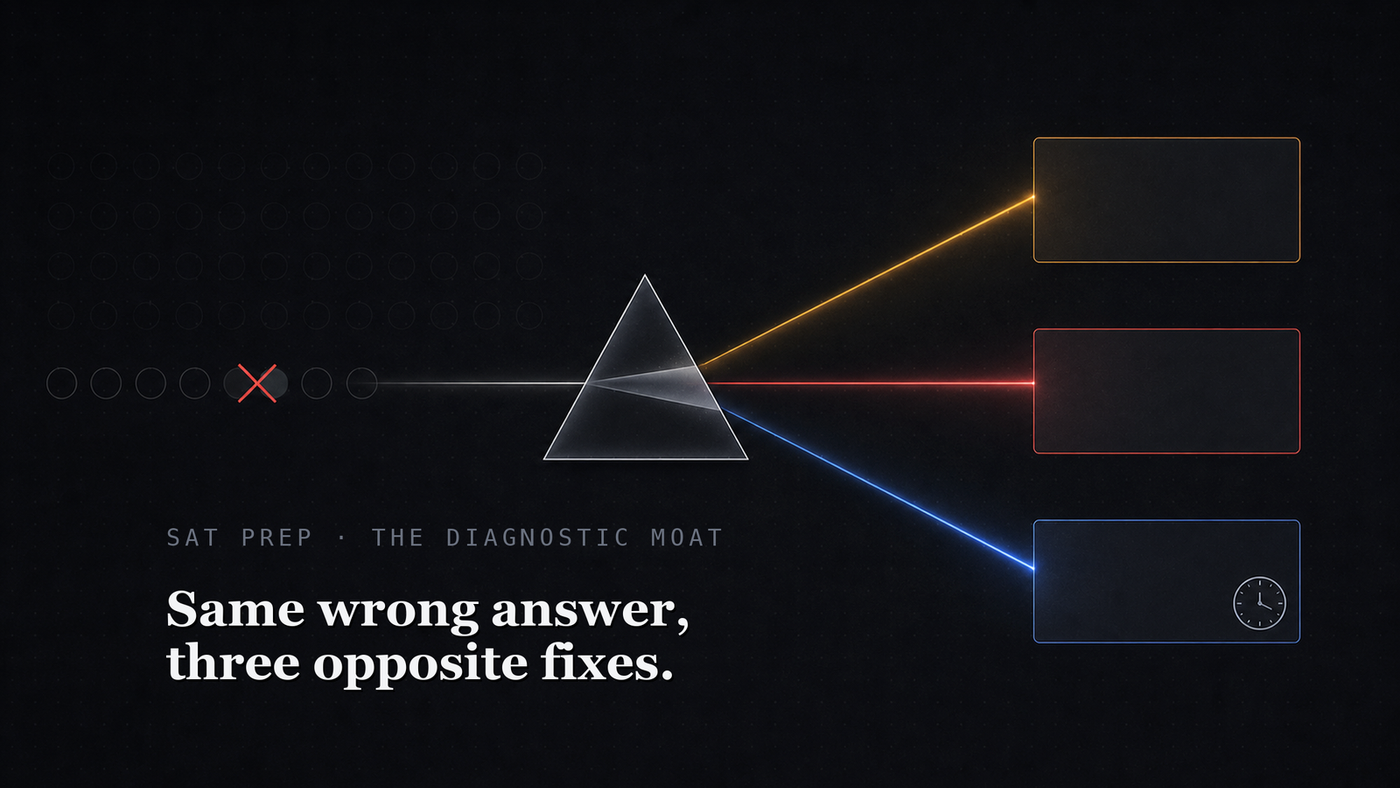
A score report that says "640 Math" tells a student nothing they can act on. It's a number, and the number is the part they already felt. The product, the thing actually worth building, is the sentence after it: you missed these four because you rushed, these three because you don't know the rule, and this one because you misread the question. Same wrong answers, three completely different fixes.
Most prep platforms sell volume, more tests, more questions, more hours, and it works for a while and then it stops cold. The data is blunt about this. A student's score climbs over the first several practice tests and then flattens, and past about the seventh test, taking another one on its own does close to nothing. A raw practice test measures the problem without diagnosing it, so after seven of them you've confirmed the problem in high resolution and changed none of it.
Three buckets, three opposite fixes
The fix is to stop counting misses and start classifying them. Every wrong answer lands in one of three buckets, and each one needs a different response. A careless error is when the student knew the rule and dropped a negative sign or misread "not"; the fix is process and pacing, not content. A concept error is a real gap, they don't actually know how the rule works; the fix is teaching, the slow kind. A pacing error is a question they would have gotten with thirty more seconds; the fix is timing strategy and triage.
The buckets matter because the wrong fix is worse than none. Drill a concept gap as if it were carelessness and you waste the student's hours on repetition that can't help. Drill carelessness as if it were a concept gap and you re-teach a rule they already know until they're bored enough to quit. The whole value of the analytics is sending each miss to the right response.
Same wrong answers, three completely different fixes. When that response is teaching a concept, whatever does the teaching has to be right every single time, which is a harder build than it looks: why an AI tutor must not do the math itself.
It's a classifier, not a dashboard
So the engine that does this isn't a progress bar, it's a classifier feeding a scheduler. For each miss it has to infer the bucket from the answer chosen, the time spent on the question, the skill the question tests, and the student's history on that skill. Then it has to generate the next round of practice against whichever bucket is costing the most points right now, not against a fixed syllabus. That's a real model with a feedback loop, and it's the part most platforms quietly skip, because a progress bar demos just as well to a parent who doesn't know the difference. It is also why the field looks the way it does: nobody actually leads SAT prep, and a wall of near-identical apps is what happens when everyone ships the interface and skips the engine.
The layer that compounds
This is also where the moat is, which is the part founders miss while they're busy on the interface. Every student who works through your platform tells you something true about which study paths actually move a score and which ones only feel productive. By 2028, when AI generates calibrated questions for almost nothing and a clean interface is table stakes, that accumulated outcome data is the one thing a competitor can't clone by spinning up a model. The content is commoditized. Knowing what to do with a specific student's specific pattern of failure is not, and it gets sharper with every student you serve. It's exactly the kind of edge worth building rather than renting.
FAQ
Why do SAT scores plateau after a few practice tests? Because a raw practice test measures the problem without diagnosing it. A student's score climbs over the first several tests and then flattens, and past about the seventh, taking another one on its own does close to nothing. You have confirmed the problem in high resolution and changed none of it.
What are the three types of wrong answer? Careless, concept, and pacing. A careless error is knowing the rule and dropping a negative sign. A concept error is a real gap in knowing how the rule works. A pacing error is a question the student would have got with thirty more seconds. Same wrong answers, three opposite fixes.
What is diagnostic analytics for test prep? Classifying every miss rather than counting misses, then sending each one to the right response. The value is in the routing: drill a concept gap as if it were carelessness and you waste the student's hours on repetition that cannot help them.
Why is a progress bar not a diagnostic engine? Because it demos just as well to a parent who does not know the difference, which is why most platforms quietly skip the real thing. An engine has to infer the bucket from the answer chosen, the time spent, the skill tested, and the student's history on that skill.
How does a diagnostic engine decide what to practise next? It generates the next round against whichever bucket is costing the most points right now, not against a fixed syllabus. That makes it a classifier feeding a scheduler, with a real feedback loop, rather than a report that tells a student a number they already felt.
Why is diagnostic data a moat? Every student who works through the platform tells you something true about which study paths actually move a score. By 2028, when AI generates calibrated questions for almost nothing and a clean interface is table stakes, that accumulated outcome data is the part a competitor cannot clone by spinning up a model.
What 2muchcoffee covers
We build the edtech analytics layer that does the real work, the classifier and the drill scheduler, not the vanity dashboard bolted on top. If your reports tell a student their score but not what to do about it, that's the gap between a platform a family pays for once and one they renew. The plain way in is the AI work we do.
One concrete action
Pull your last hundred wrong answers and hand-label each one careless, concept, or pacing. It takes an afternoon, and it tells you two things at once: whether your current product could have made that call automatically, and which bucket is actually costing your students the most points. This is one layer of building an SAT prep platform, and it's the one that compounds while the rest of the stack commoditizes.