Agentic RAG: Why Retrieval Is the Layer Under the Agent
Classic RAG is a straight line: retrieve once, then answer. Agentic RAG is a control loop, an agent that decides what to fetch, whether it was enough, and whether the question is answerable at all. Here is the real graph, and when the loop is worth its cost.

Nobody says RAG anymore. Everything is agentic now. Strip the loop off most of it, though, and you find the same model fetching the same documents with a better word on the slide. The loop is only worth its cost when it actually decides something: what to fetch, whether the pull was enough, whether the question can be answered at all. When it decides nothing, you have paid several times the tokens for branding.
Our matcher earns the loop. Type a vague request into it and it does not guess, it asks you for the role; give it a real one, a React Native engineer who has shipped a payments flow, and it comes back with a short list where every name carries the line from a real history that earned it. The hybrid search this series opened with, the dense and sparse retrieval, is one step inside that, and the ceiling on what any of it can return was set earlier still, by how the documents were parsed and chunked. The rest is the agent deciding what you asked, whether it can answer, and whether to go looking at all.
From a pipeline to a control loop
Classic RAG is a straight line. Take the question, retrieve once, put the context in the prompt, generate. It is simple and it works, right until the question needs more than one lookup, a comparison across sources, or a follow-up that depends on what just came back. Then the line breaks, because a line has no way to go back and try again.
Agentic RAG bends that line into a loop. An agent sits in the middle and makes the decisions a pipeline cannot: is this even a retrieval question, what should I fetch, was that enough, do I refine and go again. Retrieval stops being a step you run once before generating and becomes a tool the agent reaches for when it decides it needs one.
The graph is the agent
This is the actual graph behind our matcher, drawn from the code, and you can run the whole thing yourself at cv-matcher.2muchcoffee.com.
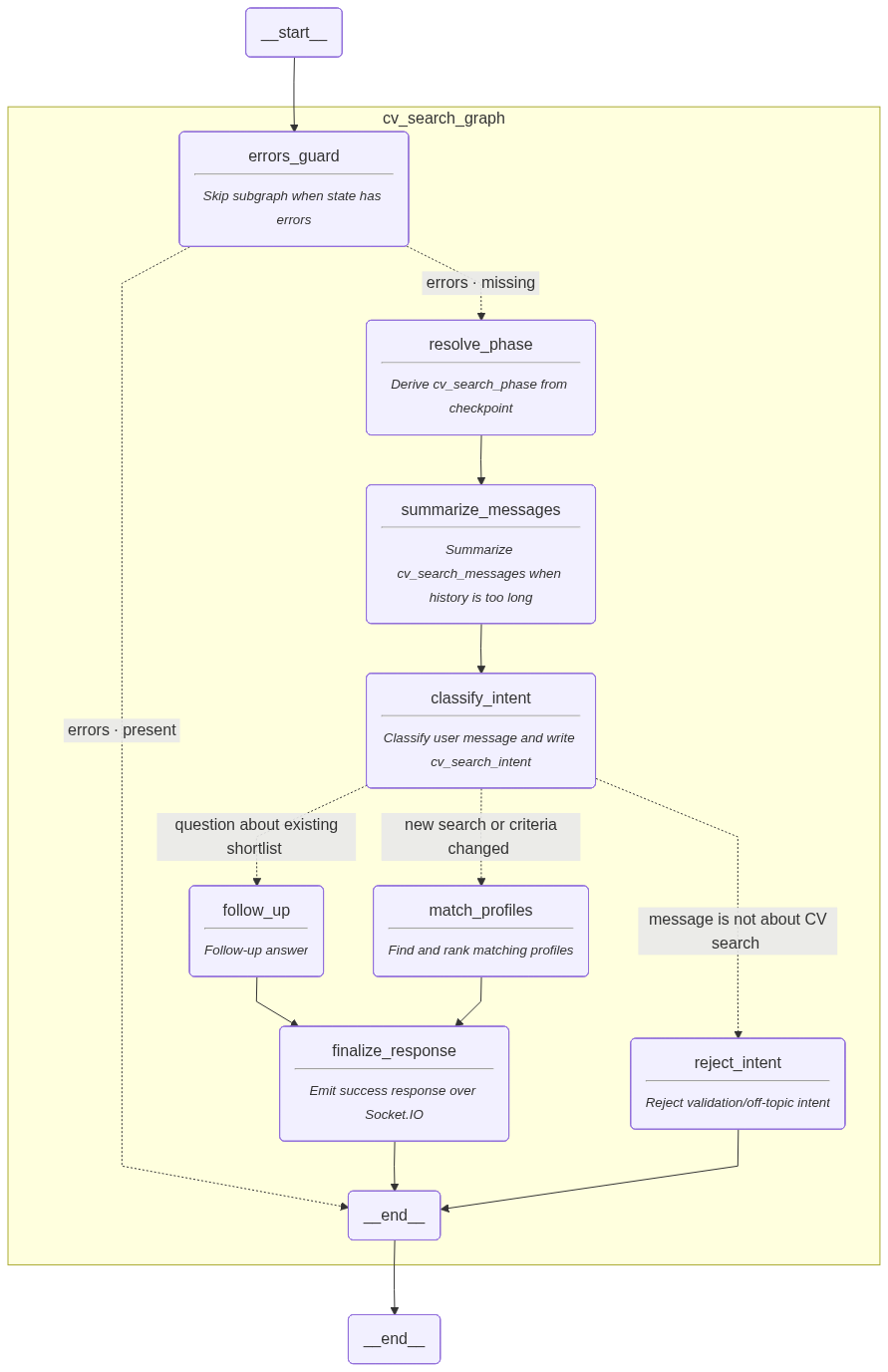
Read it once and the whole idea is there. A request comes in and classify_intent decides what kind it is. A real search routes to match_profiles, which is the hybrid retrieval from the flagship, one box on the page. A question about an existing shortlist routes to follow_up. Anything that is not a search at all routes to reject_intent. Whatever path it takes, finalize_response streams the answer back. There is a guard so a bad state skips the work, and the run keeps durable state in Postgres so a long job survives a restart.
The point of the picture is the proportion. The retrieval everyone argues about is a single node. Everything around it is the agent.
The patterns you will actually use
A handful of patterns cover most agentic RAG, and you will not need all of them. Routing, where the agent picks the path, which is our classify_intent. Re-retrieval, where a weak first pull triggers a second with refined parameters. Query rewriting, where a messy request gets cleaned into something worth searching. Self-critique, where the agent checks its own answer against what it retrieved before returning it; the productionized version of this is corrective RAG, where a lightweight evaluator grades the retrieved chunks first and triggers a rewrite or a fallback search when they come back weak, so the generator never runs on bad context. Tool use, where retrieval is one source alongside a database or a metadata lookup. Our matcher uses routing and a refusal branch and stops there, because that is what its job needs. LangGraph holds the graph together and the state lives in Postgres; the framework is not the interesting part, the decisions are.
The branch that refuses is the point
The branch that turns away an off-topic message, or asks for the role when the request is too thin, looks like a small thing on the diagram. It is the most important thing on it. A straight pipeline answers everything you send it, including the questions it has no business answering, which is exactly how a confident wrong answer ends up in front of a client. An agent can decline. It can say this is not a search, or I need more before I can help.
The sturdy version of this is not a prompt that politely asks the model to say I don't know; it is selective prediction, where the system weighs its confidence in the retrieved context and in its own trained knowledge, and refuses when neither clears the bar.
Declining is most of what trust is actually made of, and a pipeline cannot do it.
It is not free, so do not make everything an agent
Here is the honest part. Agents cost more and they are slower. A loop that retrieves, critiques, and retrieves again can burn several times the tokens of a single pass and add seconds of latency, most of it in the model calls, with a long tail on the hard questions. Which is why you cap the loop in code: a few iterations at most, plus a hard token ceiling and a wall-clock timeout, because past the third or fourth pass you are usually buying cost, not quality. That price buys real quality on open-ended, multi-step, or high-stakes work, the kind where a wrong answer is expensive. It buys almost nothing on a single-fact lookup or an FAQ, where a plain pipeline is faster, cheaper, and just as right. Whether the loop actually helped is not a feeling, by the way; you measure it the same way you measure any RAG change, with a golden set and a number.
The mature setup in 2026 is not turning everything into an agent. It is routing the simple questions to a pipeline and escalating only the ones that need the loop.
FAQ
What is agentic RAG? Agentic RAG bends the retrieval pipeline into a loop. An agent sits in the middle and makes the decisions a pipeline cannot: is this even a retrieval question, what should I fetch, was that enough, do I refine and go again. Retrieval becomes a tool the agent reaches for rather than a step that always runs.
How is agentic RAG different from a classic RAG pipeline? Classic RAG is a straight line: take the question, retrieve once, put the context in the prompt, generate. It works right until the question needs more than one lookup, a comparison across sources, or a follow-up that depends on what just came back. A line has no way to go back and try again.
What are the main agentic RAG patterns? Routing, where the agent picks the path. Re-retrieval, where a weak first pull triggers a second with refined parameters. Query rewriting, where a messy request gets cleaned into something worth searching. Self-critique, where an evaluator grades the retrieved chunks before the generator runs. And tool use, where retrieval is one source among several.
When is agentic RAG worth the extra cost? On open-ended, multi-step, or high-stakes work where a wrong answer is expensive. It buys almost nothing on a single-fact lookup or an FAQ, where a plain pipeline is faster, cheaper, and just as right. The mature setup routes simple questions to a pipeline and escalates only what needs the loop.
Why does the ability to refuse matter so much? A straight pipeline answers everything you send it, including the questions it has no business answering, which is exactly how a confident wrong answer ends up in front of a client. An agent can decline, or ask for more before it helps. Declining is most of what trust is actually made of.
How do you keep an agent loop from running away? Cap it in code: a few iterations at most, plus a hard token ceiling and a wall-clock timeout, because past the third or fourth pass you are usually buying cost rather than quality. Whether the loop helped at all is measurable with a golden set and a number, not a feeling.
What 2muchcoffee covers
Our AI engineering team builds the retrieval and the agent layer around it, and the call we make most often with a client is which questions even need the loop. If you have an agent that confidently answers things it should decline, or a pipeline straining against questions it cannot handle in one pass, that is the line we help you draw. The plain path to start is the AI work we do.
One concrete action
Ask your own system one question: when a user asks something it cannot answer, what happens. If the answer is that it answers anyway, you do not have an agent, you have a pipeline with good manners. Add the one branch that lets it decline, the refusal path, before you add anything fancier. It is the first real step from pipeline to agent, and it is the one that protects you.