The AI Tutor That Doesn't Lie: Grounding SAT Math So It Stops Teaching the Wrong Method
An AI tutor that's confidently wrong is worse than no tutor. Language models fail most multi-step SAT math because they read numbers as text, and they fail in the same sure voice they use when they're right. The fix is architectural, not a better prompt.
 Updated
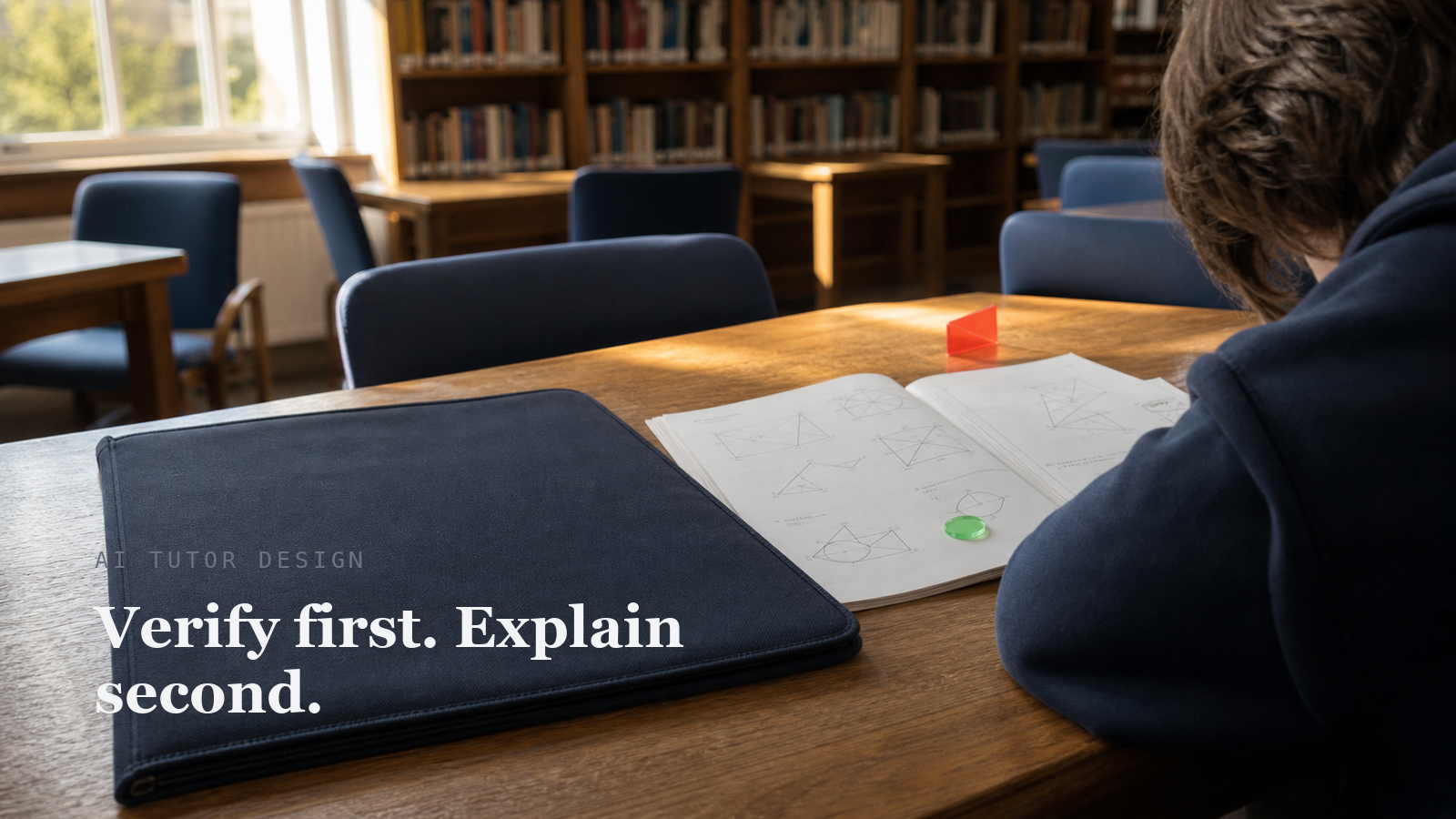
A parent watches their kid use a chatbot for algebra homework, works the same problem the old way, and finds the bot was confidently, fluently wrong. The kid's takeaway isn't "the AI made a mistake." It's that the tutor she trusted for a week has been teaching her a method that doesn't work, and nothing flagged it. An AI tutor that's confidently wrong is worse than no tutor, because at least no tutor doesn't sound sure.
This isn't a bug you patch in the next release. A language model predicts the next likely token, it doesn't do arithmetic, so it treats the numbers in a problem as text and produces what a plausible answer looks like.
A tutor that is confidently wrong is worse than no tutor, because no tutor does not sound sure. Each new model scores better on the benchmarks, and the brittleness stays: 2026 evaluations still catch frontier models dropping multi-digit arithmetic and skipping steps in exactly the multi-step compound problems the SAT is full of, and one 2026 study found newer models scoring worse than their predecessors on the same questions, so you cannot even count on the next release to fix it. The tone is the real problem anyway. A miss arrives exactly as confident as a hit, a seventeen-year-old can't tell a correct explanation from a wrong one, and so the confidence is what does the damage.
Don't let the model do the math
The fix is architectural, and it's the thing that separates a real tutor from a chatbot with a math skin. You don't let the model compute. You intercept anything quantitative, hand the actual arithmetic to a deterministic engine, a Python call, a calculator API, a symbolic solver, and let the language model do only the part it's genuinely good at: explaining a verified answer in plain language.
Think of it as three layers in order. The first validates the input, so you know exactly what's being asked and in what form. The second offloads the computation, so the number is correct by construction rather than by luck. The third generates the explanation, grounded in that verified result. Skip the middle layer and you're back to a model guessing at numbers. Keep it, and the answer is right before the model ever opens its mouth.
Solving is not tutoring
There's a distinction here that decides the whole product, and most teams building "an AI tutor" never make it. Solving a problem and tutoring a student are different jobs. A 2025 evaluation tested the leading models both ways: as solvers, they produced the correct final answer on 85.5% of college-algebra problems, a genuinely strong number. Then the same study had human evaluators act as students seeking help, and the conclusion flipped: not yet suitable as tutors without human oversight or a mechanism to guarantee correctness.
The gap makes sense the moment you look at what a tutor actually does. A solver produces its own path to an answer. A tutor has to read a student's half-finished, slightly wrong path, figure out which specific step failed and why, and respond to that. It is error diagnosis on someone else's reasoning, which is a harder and less charted problem than getting the answer right, and it is the entire job. The same classification problem sits at the heart of the diagnostic engine: knowing that an answer is wrong is cheap, knowing why is the product.
So 85.5% is the number to hold onto, because it frames the honest sales pitch of every AI-tutor feature: impressive as a demo, and still one miss in seven as a solver, before you even reach the harder tutoring problem. A parent doesn't grade on a curve. The one wrong explanation is the one they remember.
Right answer, wrong method, still a problem
There's a second kind of wrong the architecture has to catch, and it's subtler than a bad number. Even with the correct answer in hand, a model will happily explain it using a method the College Board doesn't teach, or a shortcut that falls apart on the next question. A student who learns the shortcut passes one problem and fails the variant.
That's a retrieval problem, not a math problem. The explanation has to be pulled from the actual SAT method, which is the same discipline as production RAG: ground the answer in a real source and have the model explain that, instead of inventing a plausible-sounding approach. Right number, right method, every time, or you're still teaching a confident wrong thing, just a quieter one. Knowing whether it's actually grounded takes real measurement, which is how we evaluate RAG against a fixed set of known-right answers instead of trusting a demo.
What the middle layer actually is
"Send the math to a real engine" sounds like one line of code, so it's worth being concrete about the work. The quantitative core of the tutor parses each problem into a form a machine can actually compute, symbolic where the problem is symbolic, numeric where it's numeric, and hands it to a deterministic solver: a computer-algebra system, a calculator API, a small verified script. The detail that separates a real build from a wrapper is that you verify the steps, not just the final answer. A tutor walks a student through four intermediate moves, and every one of those moves is a claim a student will trust, so every one gets checked against the engine before the model is allowed to narrate it. If the model's explanation disagrees with the verified path at any step, the explanation regenerates. The student never sees the draft that was wrong.
There's an alignment bonus specific to the SAT. The real exam ships with the Desmos calculator built in, available the entire test, so the tutor should compute with and teach the same tool the student will actually hold on test day. Calculator strategy, when to reach for it and when it wastes thirty seconds, is part of the method you're teaching, not an implementation detail.
None of this is expensive at runtime, which removes the last excuse. A symbolic check costs milliseconds next to the model call it guards. What it buys is the one property no bigger model can promise you: the difference between "usually right" and "right by construction" on the part where a wrong answer costs you the customer.
Trust is the entire product
Done right, this is the difference between a tutor that lifts scores and a liability that quietly lowers them. The upside is real: the College Board's own data links 20 hours of personalized practice to a 115-point average gain, but every point of it depends on the student trusting what the tutor says. One confidently wrong explanation and the trust is gone, and a parent who has been burned once can feel it in about three questions.
By 2028 every SAT app will have an AI-tutor button, because the model is cheap and the feature demos beautifully. That's exactly why the button stops being a differentiator. What separates the platforms still standing is whether the thing behind it is grounded or guessing. The teams that win treat "never confidently wrong" as a hard requirement, not a v2 nice-to-have.
FAQ
Can an AI tutor be trusted with math? Not if the model does the arithmetic itself. A miss arrives exactly as confident as a hit, and a seventeen-year-old cannot tell a correct explanation from a wrong one, so the confidence is what does the damage. A tutor that is confidently wrong is worse than no tutor.
Why do language models get arithmetic wrong? A language model predicts the next likely token rather than computing, so it treats the numbers in a problem as text and produces what a plausible answer looks like. Benchmarks keep improving while the brittleness stays, and one 2026 study found newer models scoring worse than their predecessors on the same questions.
How do you build an AI math tutor that is actually correct? Three layers, in order. Validate the input so you know exactly what is being asked. Offload the computation to a deterministic engine so the number is correct by construction rather than by luck. Then let the model explain that verified result. Skip the middle layer and it is guessing at numbers again.
Is solving a problem the same as tutoring a student? No, and the distinction decides the product. A 2025 evaluation found leading models produced the correct final answer on 85.5 percent of college-algebra problems, then judged them not yet suitable as tutors without oversight. A solver produces its own path; a tutor has to diagnose the failure in someone else's.
Can a right answer still be a problem? Yes. A model will happily explain a correct answer using a method the College Board does not teach, or a shortcut that falls apart on the next question. A student who learns the shortcut passes one problem and fails the variant. That is a retrieval problem, not a math problem.
Does verifying every step slow the tutor down? Barely. A symbolic check costs milliseconds next to the model call it guards. What it buys is the one property no bigger model can promise you: the difference between usually right and right by construction, with every intermediate step checked before the model is allowed to narrate it.
What 2muchcoffee covers
We build production AI tutoring and the grounding layer underneath it, the part that decides whether an explanation is trustworthy before it reaches a student. If you're putting an AI tutor in front of kids and you can't yet promise it won't teach the wrong method, that's the conversation to have before it's live, not after the first parent catches it. The plain way in is the AI work we do.
One concrete action
Take the ten hardest multi-step math problems on your platform, ask your AI tutor to solve and explain each, and have someone who knows the SAT check both the answer and the method. The error rate you find is your real product risk, and it's almost always higher than the demo suggested. This is one layer of building an SAT prep platform, and it's the layer where trust is won or quietly lost.