Online Exam Proctoring as a Chrome Extension: Integrity Without the Spyware Reputation
Students will smear lotion on a webcam to blind the proctoring AI. That's the real state of the art on the cheating side, and it's exactly why verified practice is worth more, not less, as AI makes cheating trivial. How to build integrity as signals plus a human, not surveillance theater.
 Updated
Students will smear hand lotion on a webcam lens, just enough to blur it so the proctoring model can't read a face, and then look up the answers off camera. The trick is traded openly on TikTok. That's the actual state of the art on the cheating side, and it tells you two things at once. The detector is beatable, and the person trying to beat it is creative and motivated. Any integrity layer you build starts from there, not from a vendor slide that says "AI-powered monitoring."
The instinct is that AI makes proctoring pointless, because if a model can ace the test, why watch. It's backwards. AI is exactly why a session you can trust is worth more now, not less. When a chatbot can solve the question in the next tab and a deepfake avatar can sit an exam for someone else, the value of verified practice goes up. For a prep platform there's a second reason that's easy to miss: cheated practice corrupts your diagnostics. And the scale of it is not an edge case. A systematic review puts self-reported cheating in online exams around 45%, and one study of unproctored exams found 70% of students showing dishonest behavior when nothing was watching. Unwatched practice data isn't lightly contaminated, it's majority-suspect. If a student's practice score came from a model, your analytics learn the wrong thing about them and your adaptive engine calibrates against a lie. Integrity isn't a feature bolted on the side, it's what keeps your data honest.
The pressure is already reshaping the market, and the biggest players are picking sides. ACCA, one of the world's largest accountancy bodies, is ending remote exams in March 2026 because AI-assisted cheating outran its proctoring, a full retreat to physical test centers by an organization that can afford one. A prep platform doesn't have that exit. Practice is remote by definition, so the only way through is an integrity layer that actually holds.
Signals, not a verdict
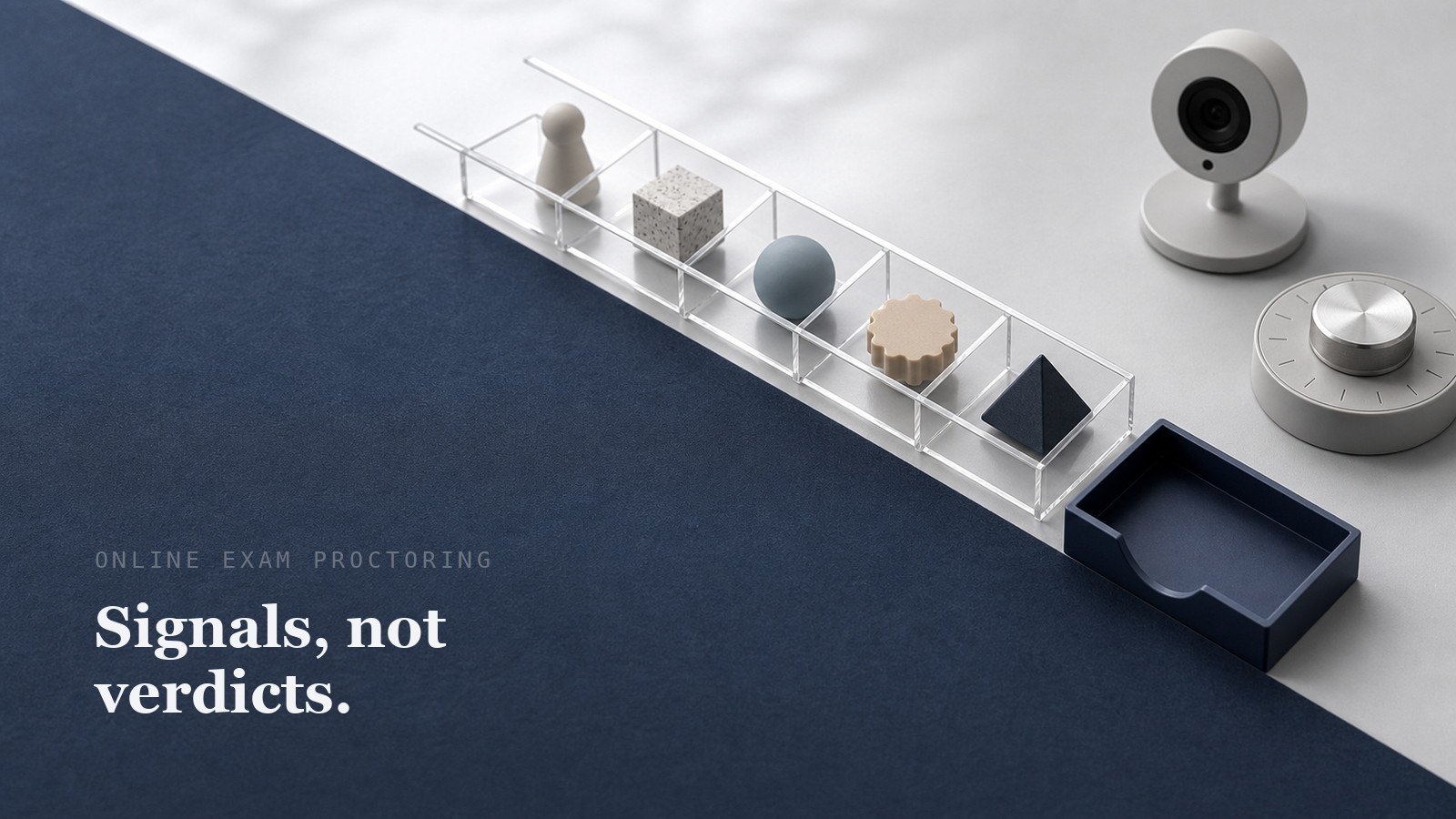
The right way to build it is signals plus a human, never an AI that renders a verdict. No single signal means cheating. A tab switch might be a sneeze and a stray click, a second face might be a parent walking past, a long look off-screen might be thinking. So you collect the signals, browser focus and tab changes, a locked-down test window, webcam presence, paste events, timing anomalies, and you combine them into a risk score that flags a session for a person to review.
The model's job is to surface the five sessions worth a look out of five thousand. It does not get to decide who fails.
This isn't a design preference, it's the conclusion the industry's biggest vendor was forced into. In 2021, ProctorU discontinued its AI-only proctoring products entirely after finding that only about ten percent of the AI's flags were ever reviewed by a human on the school side. Its CEO said the quiet part plainly: only a human can determine whether behavior is actually suspicious. The company that sold automated verdicts at scale concluded that automated verdicts don't work, and every platform that ships an AI-decides pipeline today is re-running an experiment whose result is already published.
The extension is the honest sensor
A browser extension is a clean way to deliver the part that has to live in the browser, which is why we've built proctoring that way. The extension owns the edge: locking the test window, watching focus and tab changes, blocking copy-paste, capturing the webcam and screen signals during the session. The heavy analysis runs server-side. The tradeoff is that an extension is a thing a student installs and can inspect, so you design assuming it will be probed, and you put nothing in it you can't afford a motivated seventeen-year-old to read.
It's worth being precise about what a modern extension can and cannot see, because the platform's honesty budget lives here. Under Chrome's Manifest V3, an extension gets focus and tab-switch events, fullscreen enforcement, copy-paste interception on the test page, and, with the student's explicit permission prompt, the webcam and screen during the session. What it cannot quietly do is read other tabs, log keys outside the test, or watch anything after the session ends, and that's a feature, not a limitation.
Every permission the extension requests is one the student can see and reason about at install time, so the permission screen becomes part of the trust product. If your integrity design requires a permission you'd rather the student not look at too closely, the design is wrong.
The false-positive math
Human review isn't only an ethics position, it's an economics problem you have to actually engineer. The two failure directions cost wildly different amounts. A missed cheat corrupts one student's diagnostics, which is bad and recoverable. A false accusation lands on an innocent seventeen-year-old, and what follows is a furious family, a refund, a reputation dent that compounds in a market that runs on referrals, and in Europe a legal problem, since a consequential decision with no meaningful human review is exactly what GDPR prohibits. So you tune the thresholds asymmetrically: the risk score exists to make the review queue small enough that a person genuinely reviews it, not to make the accusation for them.
That ten-percent number from the ProctorU era is the cautionary tale. When review is outsourced to whoever is busiest, a teacher, a parent, an admin with forty other jobs, it quietly stops happening, and the AI's flags become verdicts by default. The fix is structural: the review queue is part of your platform, staffed and measured like any other production system, with the reviewer's decision, not the model's, as the only thing a student ever hears.
Designing against the spyware reputation
Proctoring has a deserved bad name. Students call it spyware, and they're not wrong when it's built as maximal surveillance with an algorithm handing out punishments. The version that earns trust does the opposite: collect the minimum signal that actually predicts a problem, be explicit about what's captured, keep a human in every consequential decision, and delete what you don't need. That last part isn't only manners, it's the law in several places, and it's the whole subject of the compliance piece, which you should read before you write a line of this.
What's coming by 2028
The arms race gets worse before it gets better. Deepfake avatars and answer-in-the-other-tab are already here, identity checks that lean on webcam image matching are already beatable with synthetic video, and detection will keep chasing both. The platforms that win the trust market aren't the ones with the most aggressive surveillance, they're the ones that can prove a session was real without treating every student like a suspect. As AI makes cheating trivial, "we can verify this result" turns into a product people pay for, and it reaches well past test prep into certification and remote assessment.
FAQ
How does online exam proctoring work? You collect signals rather than verdicts: browser focus and tab changes, a locked-down test window, webcam presence, paste events, and timing anomalies. Those combine into a risk score that flags a session for a person to review. The model surfaces the few sessions worth a look. It does not decide who fails.
Does AI make exam proctoring pointless? It is backwards. When a chatbot can solve the question in the next tab and a deepfake avatar can sit an exam for someone else, a session you can trust is worth more, not less. As cheating gets trivial, verified practice becomes the thing people pay for.
Should AI decide whether a student cheated? No, and the industry's biggest vendor was forced to that conclusion. ProctorU discontinued its AI-only proctoring products in 2021 after finding only about ten percent of the AI's flags were ever reviewed by a human. Shipping an AI-decides pipeline today re-runs an experiment whose result is already published.
What can a proctoring browser extension actually see? Under Chrome's Manifest V3 it gets focus and tab-switch events, fullscreen enforcement, copy-paste interception on the test page, and, with an explicit permission prompt, the webcam and screen during the session. It cannot quietly read other tabs, log keys outside the test, or watch anything after the session ends.
Why does cheating on practice tests matter? Because it corrupts your diagnostics. If a student's practice score came from a model, your analytics learn the wrong thing about them and your adaptive engine calibrates against a lie. One study of unproctored exams found 70 percent of students showing dishonest behaviour when nothing was watching.
How do you build proctoring that is not spyware? Collect the minimum signal that actually predicts a problem, be explicit about what is captured, keep a human in every consequential decision, and delete what you do not need. In several places that last part is law rather than manners, and the permission screen itself becomes part of the trust product.
What 2muchcoffee covers
We've built proctoring as a browser extension and the server-side analysis behind it, the signal collection, the risk scoring, and the human-review queue. If you need to stand behind the integrity of a result and you don't want to ship surveillance theater to do it, that's the layer of edtech engineering to get right early. The plain way in is the AI work we do.
One concrete action
Before you write a line of detection code, write the sentence a student sees explaining what you capture and why. If you can't make that sentence honest and still have a working system, the design is wrong, not the copy. This is one layer of building an SAT prep platform, and it's the one where trust and the law meet.