The 80% Problem: Your AI-Built MVP Is a Verdict, Not a Draft
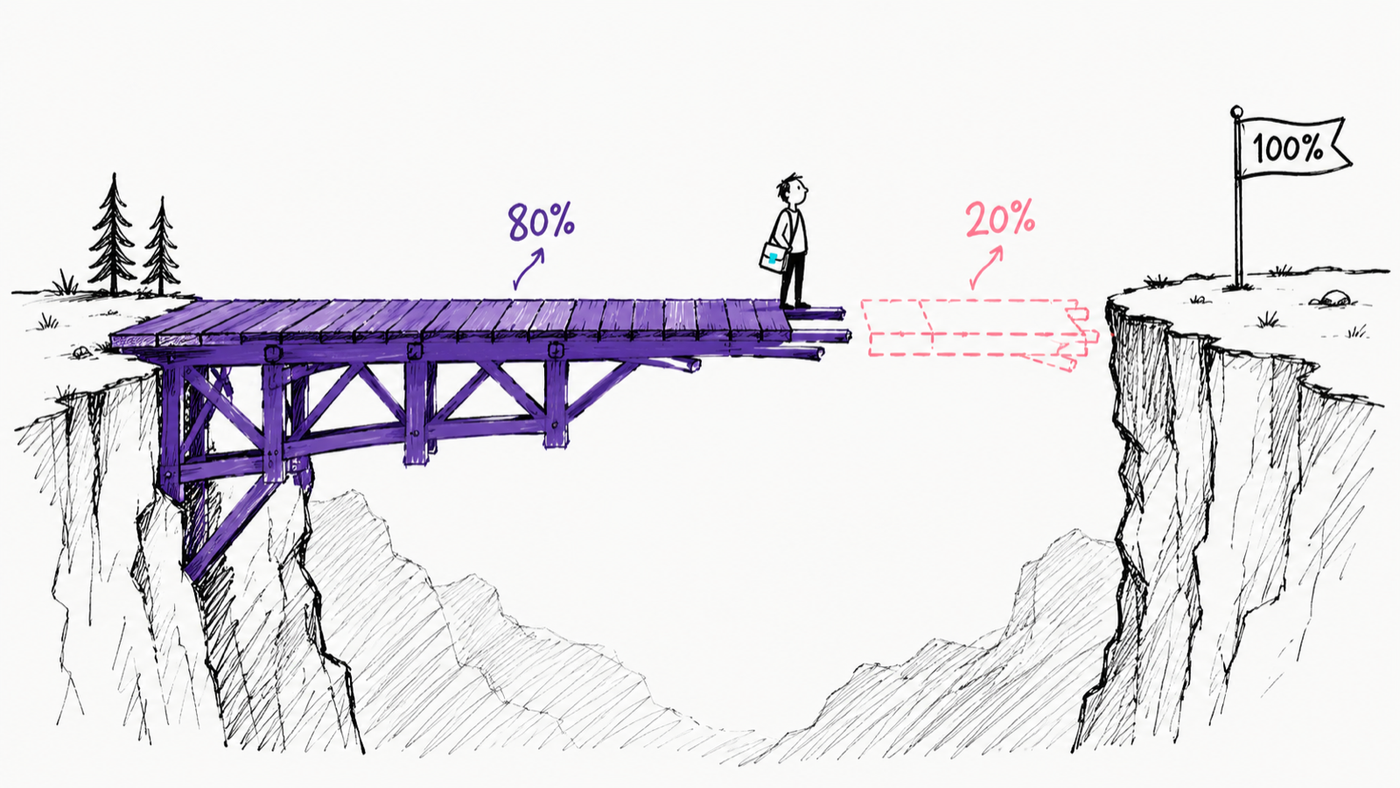
AI gets you to 80% of a product in a weekend, then stalls on the 20% that decides whether it survives real users. Most founders try to finish it. The smarter move is to read it: that 80% is a cheap verdict on whether the idea earns the expensive part.
 Updated
The most useful thing your AI-built MVP will ever do is tell you to stop building it.
That is not where anyone expects this to go. You have an app that almost works. The demo landed, the screens are there, someone said "wait, you built this?" And now you are deep in the part that will not die: the login that breaks for one user in fifty, the data that saves wrong in a way you only notice on a Tuesday, the whole thing folding the first time two people show up at once. The AI got you to 80% over a weekend. The last 20% has quietly eaten the last three.
Everyone will tell you the same thing about that last 20%: it is the hard part, go hire a real engineer to finish it. True, and it buries the more useful idea. That 80% is not an almost-finished product. It is a verdict. The cheapest, fastest read you will ever get on whether this idea earns the expensive part. And most of the time, if you actually read it instead of grinding on it, the answer is no, which is exactly why it just saved you a fortune.
Your AI-built 80% is not an almost-finished product. It is a verdict.
"Looks done" is the trap
The reason the 80% fools people is that it does not look like 80%. It looks finished. The demo runs, the happy path works, and the tests, if there are tests, go green. So the brain files it under "almost shippable, just needs polish."
Then someone measures it. Carnegie Mellon built a benchmark called SUSVIBES that takes 200 real software tasks and asks coding agents to implement them, then checks two separate things: does the code work, and is the code safe. The best setup got 61% of the tasks functionally correct and 10.5% of them secure. Read that again. Of the solutions that actually worked, more than four in five carried a live security hole.
This is not theoretical, and it is not picking on amateurs. In July 2025 the dating-safety app Tea left an open storage bucket and roughly 72,000 user images, including about 13,000 driver's licenses and verification selfies, walked out the door and onto 4chan. In January 2026 an AI social network called Moltbook shipped its database key in the browser with no row-level security, exposing 1.5 million API tokens and 35,000 emails to anyone who looked. In both cases the app worked. The demo was great. The code ran fine, the screens loaded, and nothing raised a flag right up until the part where it became a headline.
That is the trap in one sentence. The 80% is very good at looking like the 100%.
Why "just finish it" is the wrong reflex
So you hit the wall, the thing almost works, and the instinct is to push through. Hire a senior team to finish it, buy the last 20%, get it over the line. Sometimes that is right. Usually it is the most expensive question you never stopped to ask.
Because finishing assumes the thing is worth finishing. And the 80% you are staring at is the first cheap, honest signal you have ever had about that. It cost you a weekend and a few dollars of tokens. The 20% will cost you weeks and real money. Before you spend the second one, the 80% is sitting there trying to tell you something. The skill is reading it, not reflexively grinding it to 100.
There are only three things it can be telling you.
Read your 80%: kill it, fix it, or ship it
Most founders only ever weigh one of those three: finish it. The other two barely cross their mind, and that is the expensive habit, because the most valuable verdict here is usually the one nobody wants to say out loud.
The trick is to treat the 80% as the experiment it already is. It cost you a weekend, and it is allowed to come back with a no. So before you reach for an engineer, get a real scope and price each one by what it actually costs you.
What the expensive 20% actually is
If you do decide to finish, it helps to know what you are buying, because it is not "polish." The 20% is the set of things AI is reliably worst at, the ones that decide whether software survives contact with real users.
It is security, which we have covered: Veracode's testing found that across the major models, AI-generated code fails security checks about 45% of the time, and in some languages much more. It is maintainability: GitClear's analysis of hundreds of millions of lines found that refactoring collapsed from a quarter of changed code in 2021 to under a tenth by 2024, the first year duplicated code outpaced reused code. The codebase grows by copy-paste, not by structure. Addy Osmani has a name for the human side of this, "comprehension debt," the widening gap between how much code your system contains and how much any person actually understands. Unlike normal technical debt, it hides, because the code looks clean.
And it is the part founders underestimate most: the cost of finishing is not linear. METR ran a controlled trial with experienced developers on code they knew well, and found they were 19% slower with AI than without, while believing they were 20% faster. Reading, trusting, and repairing confident-but-wrong code is its own tax, and it lands hardest exactly where the 20% lives. The 80% is cheap because AI is genuinely good at it. The 20% is expensive for the same reason it is the 20%.
The half a better model cannot touch
The comforting story is that this is temporary, that the next model finishes the 20% and the problem dissolves. That is half right, and the half it gets wrong is the one that matters.
Split the 20% in two. One half is technical: security, the unhappy paths, the behavior under load. That is a code problem, and code problems yield to better models eventually, even if slower than the hype suggests. Veracode's own timeline makes the point: across two years of "revolutionary" releases, the security pass rate of AI-generated code moved from roughly 55% to roughly 55%, so the raw 80% is dangerous today whatever happens later. But grant the optimistic case anyway. Assume the models close it.
The other half does not close, because it is not a code problem. It is product judgment: whether the thing is worth building, what it should actually do, the business logic nobody wrote down because nobody had decided it yet. No model answers that, because the answer is not in the codebase. It is in the world, in your users, in a market nobody has asked yet.
A better model can write your code. It cannot decide whether the code should exist.
So this prognosis ages in reverse. The better AI gets at the code half, the more the whole 20% collapses onto the product half, the one no release notes will ever ship. The skill the founder needs is not going away, it is appreciating. Reading the 80% as a verdict, saying "this is enough to judge, not enough to build," is the part of the job that outlives every model that launches. Which is the quiet truth under "kill it": that was never a verdict about the code. It was a verdict about the idea, and no model casts it for you.
Where we come in
We build the 20%. The security, the data integrity, the scale, the unglamorous engineering that the demo never shows and the founder always needs. But the honest version of that offer starts one step earlier: we will read your 80% with you and tell you the truth about which verdict it is. Sometimes that means we tell you to kill it, and you leave having spent a weekend instead of a quarter. When it is real, we do the part that makes it safe to put in front of users and keep there. That is the work we do.
The 80% is the cheapest market research you will ever buy. Read it before you pay to finish it.
If you want the hiring-side version of this, the difference between developers who can produce the 80% and the ones with the judgment to own the 20%, we wrote that up in AI-native vs AI-powered developers. And for a concrete example of the kind of 20% that quietly ends companies, see how a single Postgres pool takes down an AI app.