Real-Time Market Data and Trading Infrastructure: Sub-Second Sync Without Lying to the User
A quote half a second stale is a quote that is wrong. A price that disagrees between the web and the app is a support ticket and a trust problem. Streaming market data at scale is a data-integrity bar, not just a websocket.
 Updated
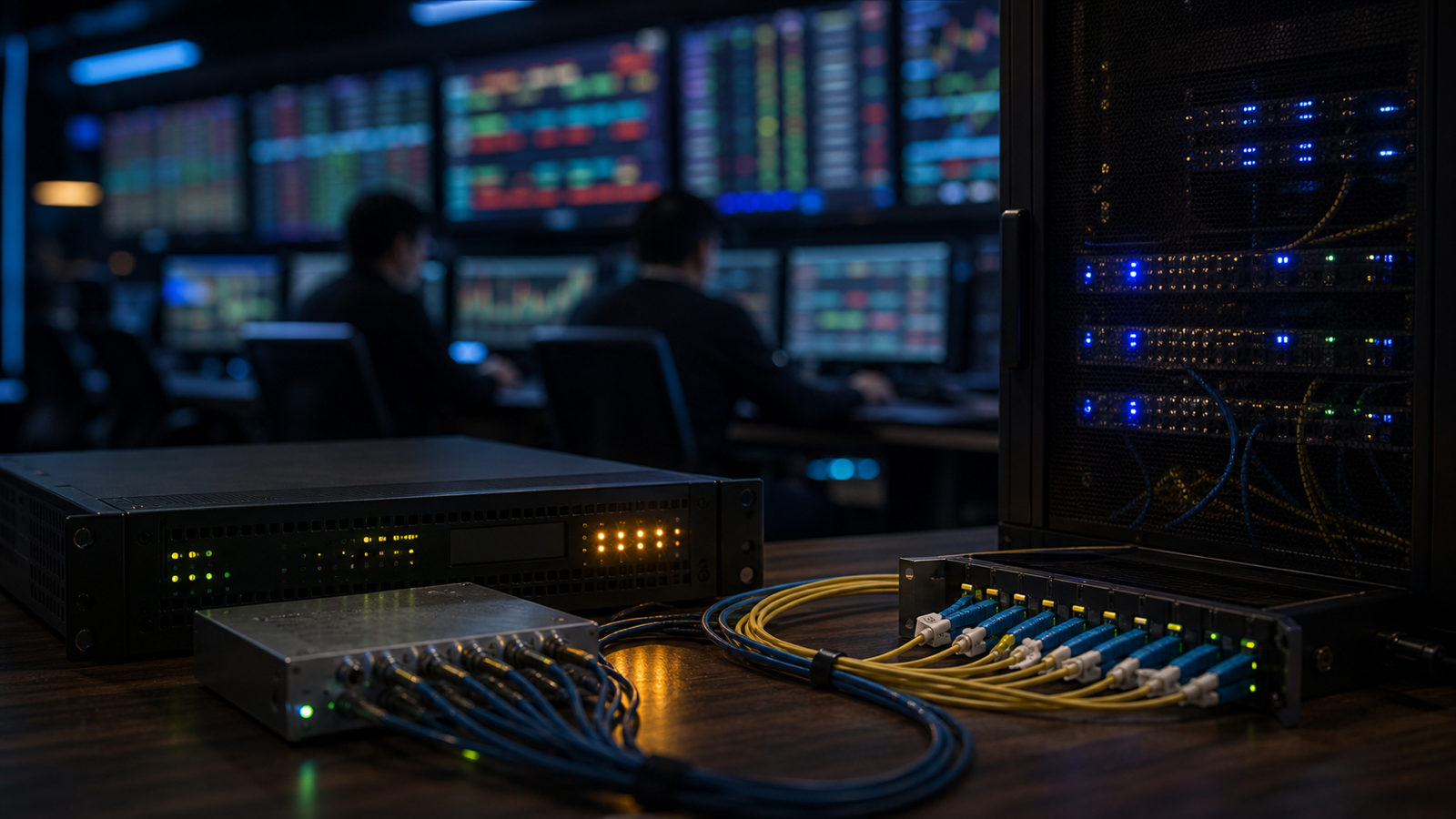
A quote that is half a second stale is not a slightly-late quote. It is a wrong number that a person might trade on. And a price that shows one value on your website and a different value in your app at the same moment is not a cosmetic glitch, it is a support ticket and, worse, a small withdrawal from the trust a user has in everything else your platform tells them. In a market-data product the number is the product, and the number being right everywhere at once is the entire job.
Here is the plain version. Streaming live financial data to a lot of people looks, from the outside, like opening a websocket and pushing prices down it. The hard part is none of that. It is keeping the number correct and consistent across every screen and device under real load, detecting when a value has gone stale and saying so instead of showing it as if it were live, and never letting a user act on a price your own system no longer believes. It is a data-integrity problem wearing a real-time costume.
The websocket is the easy 10 percent
The interesting engineering starts after the connection. You are fanning the same updates out to many clients at once, which means the moment of truth is whether all of them see the same value within the same blink, or whether some lag behind and quietly diverge. Updates have to be applied in order, because a price that arrives out of sequence and overwrites a newer one with an older one is a wrong number that looks perfectly plausible. And a user on the web and the same user on their phone have to be looking at one shared truth, not two independently drifting views, which is a state-synchronization problem far more than a transport one.
We have built exactly this kind of system, a real-time market-data and trading platform running on the web and on iOS, streaming sub-second quotes across a wide range of instruments and keeping the web and the mobile experience in sync so the same price means the same thing on both. The lesson that work teaches is that the visible feature, the ticker that updates, is the small part. The part that takes real engineering is everything that keeps that ticker honest when ten thousand people are watching it move.
Say "stale" out loud
The failure that erodes trust quietly is the stale value that still looks live. A feed hiccups, an upstream goes quiet, a connection degrades, and the last known price just sits there looking current. The discipline is to treat freshness as a first-class property of every value: track when you last truly knew it, and when that confidence lapses, mark the number as stale to the user rather than letting them believe it. This is the same instinct as refusing to trust a silently wrong data feed, pointed at time instead of schema. Under heavy load you also need backpressure, a deliberate answer to what happens when updates arrive faster than clients can consume them, because the wrong answer is an ever-growing queue that serves everyone increasingly old data while pretending to be real-time.
The throughline is that a wrong number presented confidently is worse than an honest gap, especially when there is real money on the other side of the decision. Every part of this is about making sure the platform never tells a user something it does not actually believe.
A wrong number presented confidently is worse than an honest gap.
The market is about to stop sleeping
Until now, every market-data platform got a nightly gift: hours of closed markets to run migrations, rebuild caches, and let the queues drain. That gift is being withdrawn. In April 2026 the SEC approved Nasdaq's plan to trade 23 hours a day, five days a week: a day session from 4 a.m. to 8 p.m. Eastern, a single hour for maintenance, testing, and clearing, then a night session from 9 p.m. to 4 a.m. The schedule is expected to start December 6, 2026, conditioned on the securities information processor being ready, and Nasdaq will not be alone: the New York Stock Exchange and 24X hold preliminary approvals for the same shape of day, DTCC is expected to bring nonstop stock clearing by the end of 2026, and the SEC has set a roundtable on 24-hour readiness for September 17, 2026.
Every discipline in this article gets harder on that clock. Staleness detection matters more when there is almost no closed-market period left for a wrong number to hide in. Overnight sessions will run thinner, and thin sessions make a stale quote more dangerous, not less, because fewer trades mean fewer corrections. The maintenance you used to spread across a quiet night now has to fit one hour or happen live. And the cross-device consistency problem never gets a reset: the web and the phone have to agree at 2 a.m. exactly the way they agree at 2 p.m. Europe is tightening its own clock too, with the UK, EU, and Switzerland moving settlement to T+1 together on October 11, 2027. If any part of your platform's honesty quietly depends on the market pausing, you have until December to find it.
What's still standing in 2028
AI will render the chart and generate parts of the pipeline. What it does not give you is the integrity bar: the ordering guarantees, the staleness honesty, the cross-device consistency. By 2028 the real-time chart is free, and the number you can actually stake a decision on is the moat, because that was always the hard part and it is now the only scarce one.
FAQ
Why is a stale quote wrong rather than just late? Because a person might trade on it. A quote half a second stale is not a slightly-late number, it is a wrong number wearing a live one's face, and the last known price sitting there looking current is the exact failure that erodes trust quietly. Freshness has to be a first-class property of every value.
How do trading platforms keep web and mobile in sync? By treating it as a state-synchronization problem rather than a transport one. A user on the web and the same user on their phone have to look at one shared truth, not two independently drifting views, so every client sees the same value within the same blink or the platform is lying to someone.
What is backpressure in market data? A deliberate answer to what happens when updates arrive faster than clients can consume them. The wrong answer is an ever-growing queue that serves everyone increasingly old data while pretending to be real-time, which turns a performance problem into an honesty problem.
What changes when US stocks trade 23 hours a day? The SEC approved Nasdaq's 23-hour, five-day schedule in April 2026, expected to start that December. Staleness detection loses the closed-market hours a wrong number could hide in, maintenance compresses into a single hour, and thinner overnight sessions make a stale quote more dangerous because fewer trades mean fewer corrections.
Why must price updates be applied in order? Because a price that arrives out of sequence and overwrites a newer value with an older one produces a wrong number that looks perfectly plausible. Ordering guarantees sit in the integrity bar next to staleness honesty; without them the ticker updates convincingly and lies.
What is the hardest part of building a trading platform? Not the websocket, which is the easy 10 percent. The hard part is everything that keeps the ticker honest when ten thousand people are watching it move: applying updates in order, detecting staleness and saying it out loud, and keeping web and mobile in perfect agreement under real load.
What 2muchcoffee covers
We build and harden real-time financial systems, the streaming and fan-out, the ordering and state sync across web and mobile, the staleness detection that keeps a quote from lying. If you are building anything where a number has to be right, identical everywhere, and current to the moment, that is the engineering we do and the conversation worth having early. The plain way in is the AI and engineering work we do.
One concrete action
Take the most important live number on your platform and ask two questions: if it goes stale, does the user find out, and if the web and the app disagree about it for a second, which one is wrong and how would you know. If you cannot answer both cleanly, that is the part of building fintech software to harden first, because in a market-data product the number's honesty is the whole product.