Top 5 Skills a Non-Technical Co-Founder Needs in 2026
AI builders made shipping cheap. Owning the source code, security, developer accounts, distribution, and a defensible niche is the work AI will not do for you.
 Updated

Five things will probably go wrong with your AI-built product this year. A non-profit founder told me about one of them this morning.
He lost his entire codebase. The freelancer who built his web app stopped answering messages, the repository was on a personal account nobody in the org could reach, there was no backup, and there was no transfer plan. There was just a working product that quietly stopped being theirs.
In 2026, building the app is no longer the hard part. AI builders like Lovable, Replit, Base44, Bolt, and Rork ship working products in days, sometimes faster. The hard part for a non-technical co-founder is owning what got built: the source code, the security posture, the publishing accounts, the distribution channel, and a real reason for the product to exist. Five walls. None of them are coding problems.
Own the source code
The story above is not unusual. Project-rescue services exist as a category in 2026 and market themselves explicitly around the developer-ghosted-you scenario. Founders pay tens of thousands of dollars upfront, the developer disappears, and what arrives is either an unmaintainable mess or a complete lockout, not what real MVP development for startups is supposed to look like.
The minimum bar is unglamorous. Create a GitHub or GitLab Organization under your company email, not your developer's personal account. GitHub's own documentation warns that single-owner organizations become inaccessible if that owner is unreachable, so always have at least two Owners inside your company. Give contractors a Maintainer role, turn on branch protection for main, and write the IP assignment into the contract before anyone touches a keyboard. Source-code escrow services like Codekeeper and The Escrow Company still operate and are worth the small monthly fee on serious projects.
You do not need to learn how to code. You need to own the history. Five commands are enough:
If you cannot run those, you do not own your codebase. You are renting it from whoever does.
Security practices
You are already using AI to write the spec. You used it for research. You used it to generate generic-quality design. The same prompt box can review your application's security, best coding practices, and scalable architecture, and most non-technical founders never ask. Skipping that prompt is a choice, not a limitation.
The cost is documented. Veracode's 2025 GenAI Code Security Report found that 45% of code samples failed security tests, with Java the worst at 72%, and models kept getting better at working code without getting any better at secure code. Sherlock Forensics's 2026 AI Code Security Report found that 92% of the AI-generated codebases it assessed carried at least one critical vulnerability, averaging 8.3 exploitable findings each, the kind of gap between looks-done and actually-done we have covered before. In April 2026, Lovable disclosed a broken object-level authorization vulnerability that exposed source code, Supabase credentials, AI chat history, and customer data across thousands of customer projects. None of those incidents required exotic attacks. They required defaults that the prompts never touched.
The defaults are predictable: Supabase anon and service-role keys in the frontend bundle, hardcoded Firebase configs, .env files committed to Git, and Row Level Security either missing or wide open because the original prompt said "make it work fast." The fix costs nothing. Open the same prompt box you used to build the app and run this:
You are an expert security architect and senior full-stack engineer with 15+ years shipping production SaaS. Review this entire AI-generated codebase (paste the full repo or the key files) against the items below. Be brutally specific, cite exact file and line, and give me the exact code changes or the new prompts to feed the builder.

1. Secrets and credentials
   - Hardcoded API keys, DB credentials, Supabase or Firebase keys, JWT secrets, or env vars in client-side code.
   - Plaintext secrets in client bundles, .env files committed to Git, or fallback credentials in shipped JS.

2. Authentication and authorization
   - Row Level Security on every Supabase table.
   - Proper auth guards on every API route. No BOLA or IDOR.
   - Rate limiting, input sanitization, prompt-injection defenses.

3. OWASP Top 10 and common AI pitfalls
   - XSS, CSRF, insecure deserialization, broken access control, security misconfigs.
   - LLM-specific issues: system prompt leakage, tool-use abuse, data exfiltration.

4. Scalable architecture and best practices
   - Production-ready changes for security, performance, cost, and maintainability.

Output:
(a) Critical fixes that must ship before production.
(b) High-priority improvements to schedule next.
(c) Refactored code snippets for the highest-risk areas.
(d) A short security checklist I can paste into future prompts so this never regresses.
Run this in Cursor, VSCode with Claude Code, or another tool that operates on your local repo. Avoid pasting your full codebase into public chat windows that may log or train on it. Apply the critical fixes first.
It is the same prompt box. Skipping is a choice.
Own your developer accounts
If your contractor publishes your iOS app under their personal Apple ID, you do not own your app. You own a license to use whatever they decide to keep available. The same is true on Google Play. Nobody warns you about this until the contractor stops responding.
The minimum setup is straightforward. Apple's Developer Program supports Organization enrollment, which requires a legal entity and a D-U-N-S Number. The Account Holder must be a founder or legal signatory inside your company. Contractors get the Admin role at most, never Account Holder. Apple's App Transfer process exists for moving published apps between accounts, but the source Account Holder must initiate it, and Apple will not unilaterally hand over ownership without legal proof.
Google Play Console works on the same principle. The account belongs to a verified entity, transfers carry a cooling-off period, and Android developer verification is rolling out as mandatory in Brazil, Indonesia, Singapore, and Thailand from September 2026, with a global rollout planned for 2027. If a contractor created your account in their personal Gmail, recovery often becomes a support ticket and a fight. The cleanest version is the one that never needs that fight: company entity, founder as Owner, contractors as Manager or upload-only access.
Distribution and niche marketing
The world is full of generic AI-built apps. Lovable, Replit, Base44, Bolt, and Rork helped a flood of fitness trackers, macros calculators, journaling tools, and diet-advice wrappers reach the App Store in the last year. Most of them have no users.
Building cost crashed. Distribution cost did not, and LLM wrappers face a worse version of the problem because every paying user costs inference money. A wrapper at 15 dollars a month that pays 4 dollars in token costs and 20 dollars in customer acquisition is losing money on every signup before it earns a referral. The phrase "wrapper trap" came from Reddit teardowns for a reason.
The skill a non-technical co-founder still has to learn is distribution. That means a one-sentence ICP definition you can repeat from memory, a deliberate channel choice instead of posting everywhere, and a small toolkit you actually use: Instantly or Smartlead for cold email, Clay for enrichment, Beehiiv or Substack for the niche newsletter, Loom and Notion for sales conversations.
The unsexy part is the part that works. Call your customers. Twenty to thirty calls a week. Ask one question first: what is the one thing that would make you cancel tomorrow? Log the answers in a spreadsheet, turn the answers into roadmap and copy, and stop spending money on ads until you have heard the same complaint three times.
Find your niche and your competitive advantage
A global idea is brutally hard to find in 2026. The supply of generic AI-built apps makes "be the breakthrough" an unrealistic goal for almost anyone, and a defensible niche is not the consolation prize. It is how you build a stable business while the global-idea founders burn through their savings.
Be honest about which moats are reachable for a non-technical co-founder. Proprietary data you already collect, distribution through your existing network, integrations with niche tools you know cold, brand and trust inside a vertical, and lived experience in a regulated field are all reachable. Network effects at small scale, proprietary algorithms, and pure technology moats are mostly myth at this stage and should not anchor your strategy.
There is a one-week test for whether your niche is real. Name 50 actual people, not personas, who have the exact pain, have the budget, and would pay you tomorrow. Call ten of them. If at least seven say a version of "shut up and take my money," you have a niche. If your honest answer is "everyone," you do not.
Five walls and one silent killer
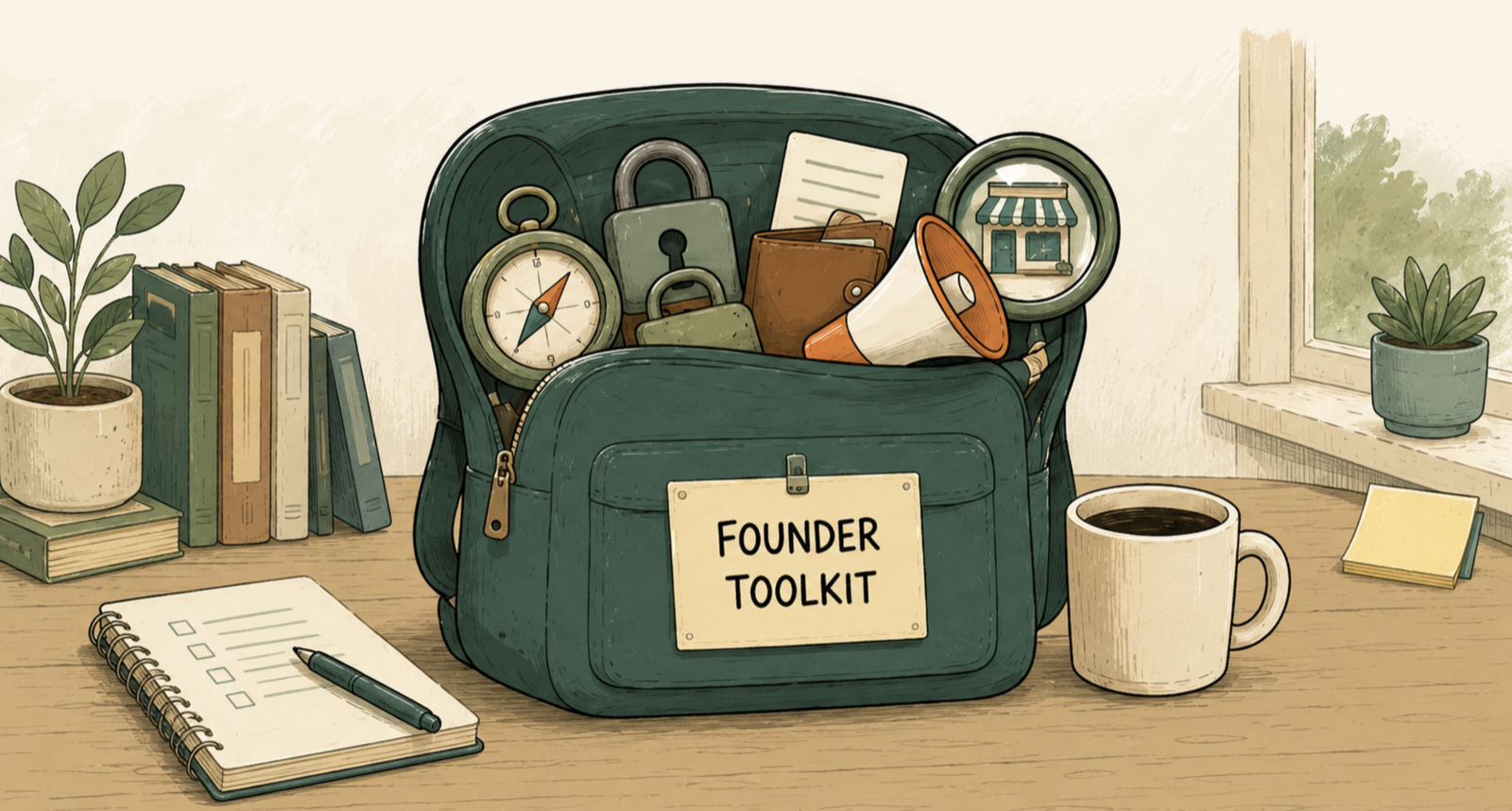
Source code, security, developer accounts, distribution, and a niche worth defending. The AI builders that made shipping cheap will not own any of those for you, and the contracts and IP assignments that hold them together are the silent hygiene item that amplifies every wall when it is missing.
In 2026, "non-technical" cannot mean "helpless about your own software." It means knowing exactly which parts of the company you have to own, even when the tool that built them is doing most of the typing.
Which of these five did you underestimate?
If you want a second pair of eyes on a vibe-coded app before it reaches production, or want to scope your MVP before you build at all, 2muchcoffee can help through the AI development page or the contact form.